


In this section:
Plantar Digital Neuroma Metatarsalgia Lesser toe deformitiesTailor’s bunion (Bunionette)Pain Activity Ladder Ankle, Foot and Toe ExerciseFootwear Advice Video
Plantar Digital Neuroma (Morton’s Neuroma)
What is a Plantar Digital Neuroma?
Morton’s neuroma can be a painful condition that affects the nerves that runs between your toes in the ball of the foot. People between the ages of 35 and 60 are more prone to developing this condition but it can happen at any age, affecting women more than men.
It develops because of irritation and thickening in the nerves that supply your toes, triggering pain and numbness. Treatment for Morton’s neuroma usually begins with self-care.
Morton’s neuroma is a thickening of one of the plantar digital nerves in your foot. The plantar digital nerves run between the long bones (metatarsals) in your feet and provide sensation in your toes. The nerves most commonly involved are the ones that supply the 3rd and 4th toes but any of the plantar digital nerves can be affected. These nerves can experience a significant amount of stress and pressure which could result in damage and thickening to happen. Unfortunately, as the nerve thickens, the pressure around the nerve can increase resulting in pain and numbness in your forefoot and toes.
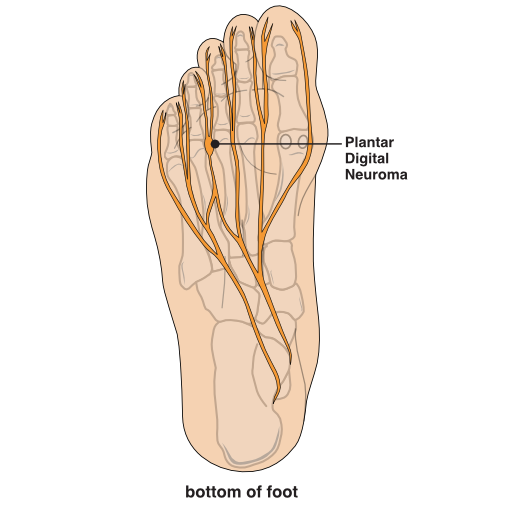
The pain usually starts in the ball of the foot and can spread into your toes. Burning, tingling or numbness between the affected toes may also be felt. Some people describe the pain like they are walking on a pebble or have a lump on their foot. Symptoms will be aggravated when wearing tight fitting footwear. Removing your shoes and massaging the area can often help relieve the pain.
You may experience any or all of the following:
- Sensation of walking on a `pebble’ or `lump’
- A sharp, stabbing, burning or tingling sensation affecting the ball of the foot and into the toes
- Pain more commonly affecting the 3rd and 4th toes, can affect all other toes
- Pain on walking, aggravated when putting on or wearing ill- fitting footwear
- Relieved by removing footwear and massaging foot
The exact cause of Morton’s neuroma is not known. It is thought to develop due to increased stress and irritation on one of the plantar digital nerves. This increased stress may cause the nerve to be compressed, rubbed, or stretched. Ill-fitting footwear is a well- known cause in aggravating your symptoms.
You may have contributing factors related to a Plantar Digital Neuroma (Morton’s Neuroma):
- Ill–fitting footwear that is too narrow or has a thin sole i.e. high heeled shoe
- Being overweight
- Foot deformities such as hallux valgus (bunion), hammer toes
- Inflammatory conditions i.e. rheumatoid arthritis, psoriatic arthritis etc.
- Previous foot trauma i.e. metatarsal fracture, nerve injury
- Weakness in the muscles within your foot or leg
- Tightness in the muscles up the backs of your legs may cause you to load more through your forefoot
- Wearing unsupportive footwear such as shoes or sandals which have a low heel
- Spending long periods standing, walking or running, especially with a sudden increase in these activities. What causes a neuroma?
Unfortunately, there is no quick or easy fix and your symptoms will not improve overnight. We would advise you follow the advice below for Morton’s neuroma in the first instance. The advice is aimed at reducing the pressure and inflammation from around the affected nerve. The main focus is on footwear and decreasing any tightness in the calf muscles. Tight calf muscles can increase the pressures through your fore foot. Your pain should improve but may take time to get better.
Making changes to your lifestyle as well as reducing aggravating activities is key to helping your recovery. Only you can do this.
With Morton’s neuroma it is important to make sure that your footwear fits you well and are not too tight across the fore foot. Narrow footwear will increase compression on the nerves. Shoes with a deep and wide toe box are preferable.
Avoid high-heeled, narrow or pointed-toe shoes as these could further increase the pressure on the nerves. Footwear that have thin, hard soles should also be avoided as these will not provide enough cushioning or shock absorption that can also increase the pressure on your nerves. Shoes with laces or adjustable straps are best.
watch the Footwear Advice Video for more information
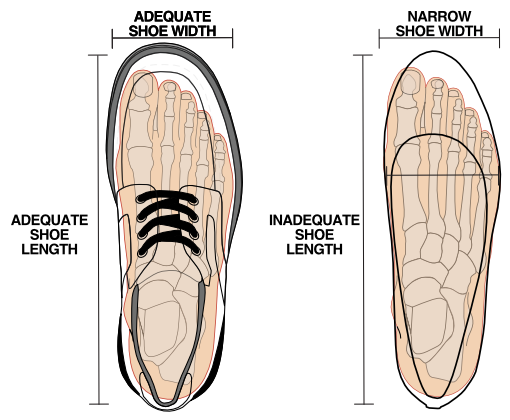
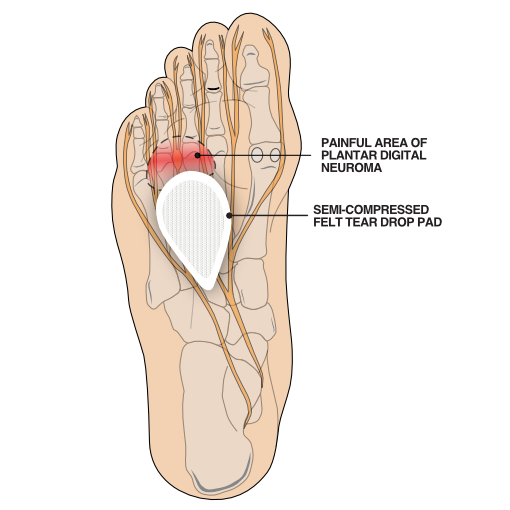
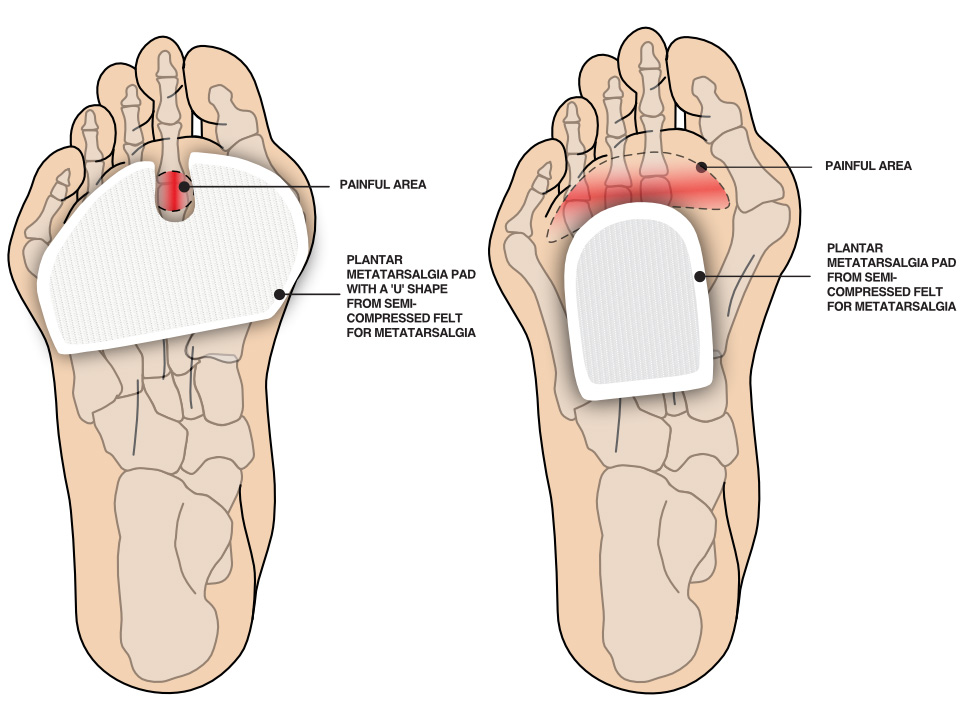
Some people find benefit from wearing a metatarsal pad on the bottom of their foot or on an insole to help reduce the pressure on the nerve. A metatarsal pad is a soft pad which sits just behind the ball of your foot rather than directly underneath it. It is important to place the metatarsal pad in the correct position, ideally 5mm behind the metatarsal heads as shown in the diagram. These pads help to reduce the pressure on the nerve and can be bought from the local pharmacy or online.
Metatarsalgia (Ball of the foot pain)
What is Metatarsalgia?
Metatarsalgia or ball of the foot pain is very common and will affect around 80% of the population at some point in their life. It is made up of a group of conditions that can cause pain and inflammation around the bones and joints in the ball of the foot. Finding comfortable footwear can be difficult.
Treatment protocols for ball-of-the-foot pain almost always start with basic principles and we would encourage you to consider trying some self-help treatment before making a referral to your local Podiatry department.
The most common conditions affecting the ball of the foot are:
- Fat pad atrophy
- Capsulitis
- Intermetatarsal bursitis
- Plantar plate injury
Fat pad atrophy
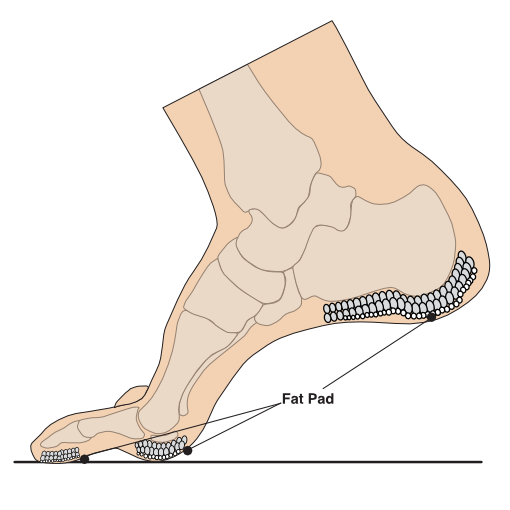
Fat pad atrophy is a term used to describe thinning and degeneration of the fat pad that sits under the ball of your foot. The fat pad is the soft tissue layer in between the skin and the bones. It has a honeycombed structure with fibro-elastic chambers containing fat globules which helps with shock absorption and the spreading of pressure across the ball of your foot during activity.
Thinning of the fat pad can lead to reduced shock absorption, making the foot more vulnerable to repetitive micro-trauma and developing inflammation, bruising, swelling and pain.
Thinning of the fat pad is a natural process and begins around the age of 30. It can take several years before the fat pad becomes thin enough to cause pain to develop. Fat pad atrophy is more common in people with Diabetes.
Capsulitis
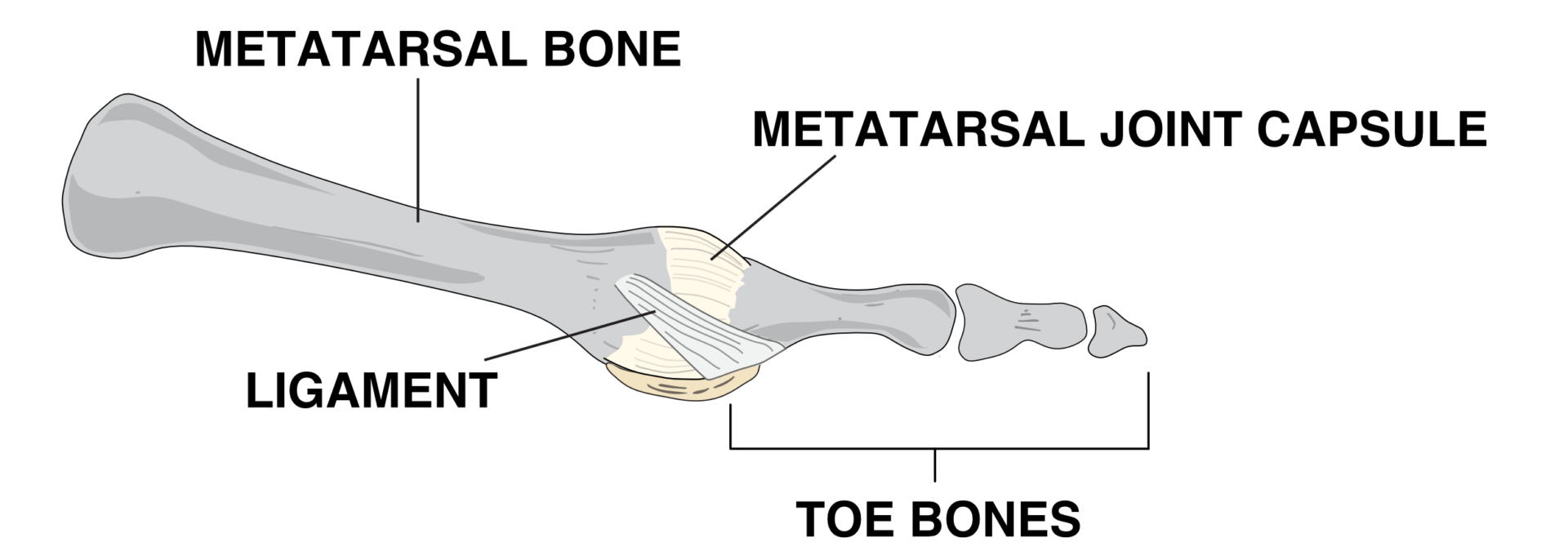
Capsulitis is a term used to describe inflammation of a joint capsule.
A joint capsule is a covering that surrounds a joint and consists of a thick outer layer which gives it its strength and a thinner synovial layer which produces the fluid to lubricate the joint. Micro trauma or damage to the joint capsule can result in excess fluid being produced which causes the joint to swell and become painful when weight bearing. In your foot it most commonly affects the joint next to the big toe but can affect any joint within the body.
Intermetatarsal bursitis
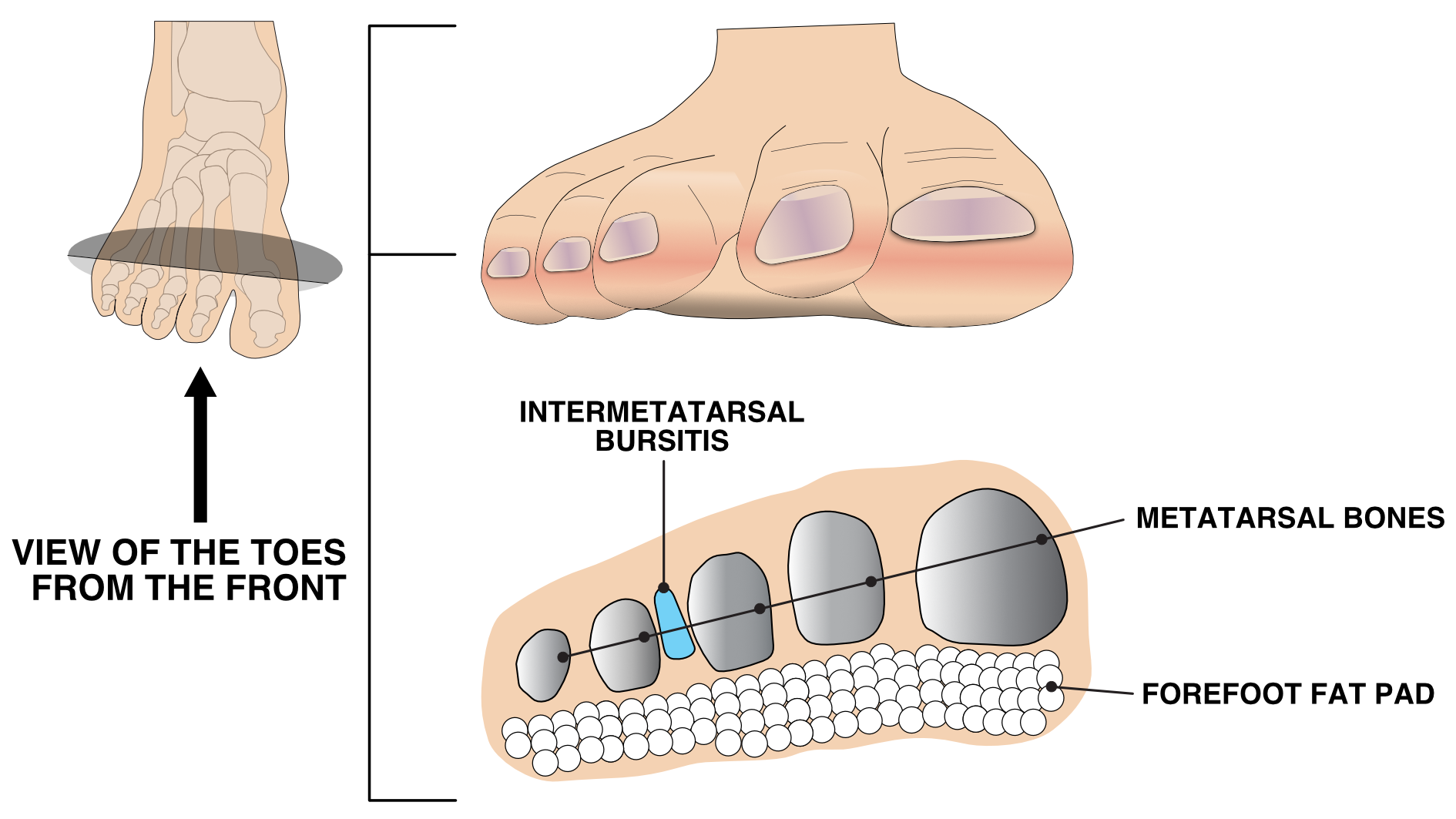
Intermetatarsal bursitis is an inflammation of one of the bursa that is between the joints in the ball of the foot.
A bursa is a small sac of fluid that can help to increase shock absorption and reduce friction, its position within the ball of the foot is important as it helps prevent the bones from rubbing together.
When the bursa becomes inflamed it can swell and become painful when weight bearing. Tight fitting shoes can increase the compression of the bursa resulting in pain.
Plantar plate injury
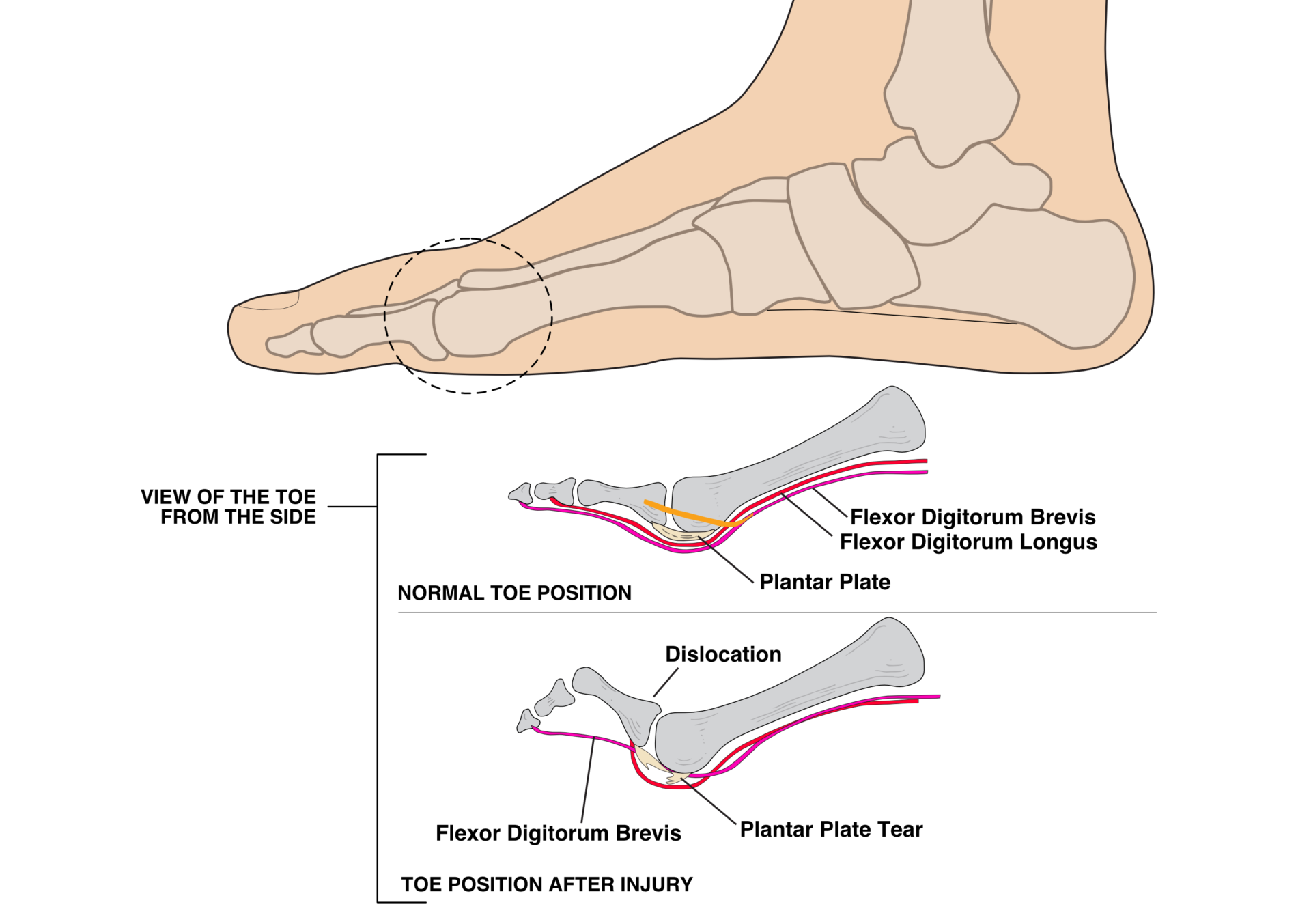
The plantar plates are deep ligaments that form the bottom part of the joint capsule within each of the joints in the ball of the foot. The plantar plates help to stabilize the foot and toes when weight bearing and also provide the attachment of the plantar fascia into the base of the toes.
Repeated micro trauma can lead to tearing or partial tearing of the plantar plate. If left untreated this can cause deformity of the affected toe.
You may experience any or all of the following:
- A sharp, stabbing, burning or tingling sensation affecting the ball of the foot and into the toes
- Pain that increases with weight bearing activity and improves with rest
- Sensation of walking on a `pebble’ or `lump’
- Increased pain when walking barefoot, especially on a hard surface. The most common cause of pain in the ball of the foot is from a sudden increase in pressure or activity resulting in micro trauma and inflammation.
You may have contributing factor related to metatarsalgia (ball of the foot pain):
- Being over-weight
- Age – the fat pad under the ball of the foot becomes thinner and this can increase pressure at the front of the foot.
- Increased swelling in feet
- High arched feet
- Tightness in the muscles in the back of the leg
- Weakness within the muscles in your foot/leg
- Unsuitable footwear that is too narrow or has a thin sole i.e. High heeled shoe
- Foot deformities such as hallux valgus (bunion), hallux limitus and hammer toe deformities
- Inflammatory conditions i.e. rheumatoid arthritis, psoriatic arthritis etc.
- Previous foot trauma i.e. metatarsal fracture, nerve injury
- Spending long periods standing, walking or running, especially with a sudden increase in these activities
Unfortunately there is no quick or easy fix and your symptoms won’t improve overnight. It is important though that if you have any of the contributing factors you make the necessary changes to help with your recovery.
The advice below is aimed at reducing the pressure and inflammation from around the affected joints with a main focus on footwear and decreasing any tightness in the calf muscles. Tight calf muscles can increase the pressures through your forefoot (the front part of your foot). Your pain should improve but may take time to get better.
Making changes to your lifestyle as well as reducing aggravating activities is key to helping your recovery. Only you can do this.
There are a number of things you can try including:
- Rest and raise your foot on a stool when you can
- Put an ice pack (or bag of frozen peas) in a towel on the painful area for up to 20 minutes every 2 to 3 hours
- Wear shoes with cushioned heels and good arch support
- Use insoles in your footwear
- Try regular stretching and foot exercises
- Try exercises which put no pressure on your feet, such as swimming
- Try to lose weight if you’re overweight or obese
These a number of things to try to avoid including:
- Avoid walking or standing for long periods
- Avoid wearing high heels and tight pointy shoes
- Avoid wearing flip-flops or backless slippers
- Avoid walking barefoot on hard surfaces
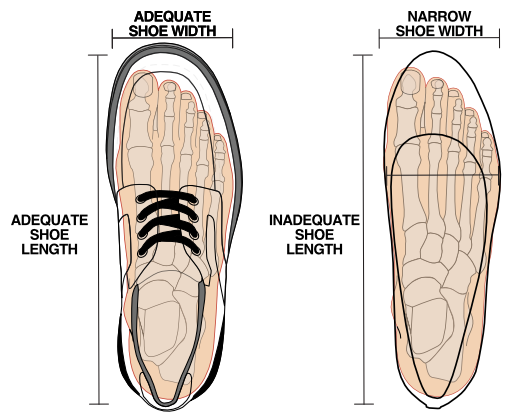
With ball of the foot pain it is important to make sure that your footwear fits well and are not too tight across the fore foot. Narrow footwear will increase compression through the joints and increase your pain. Shoes with a deep and wide toe box are preferable.
watch the Footwear Advice Video for more information
Padding can be applied to the bottom of the foot or on an insole, to help cushion and reduce the pressure on the joints. Padding comes in a variety of materials and can be bought from your local pharmacy or online.
Lesser Toe Deformities
What are Lesser Toe Deformities?
Lesser toe deformities are changes in the shape of any of the four smaller toes of your foot. These changes can often cause pain in the toe itself or can be uncomfortable when wearing shoes due to friction and pressure of the toes against the shoe. These changes are commonly seen in the second toe but can affect any of the lesser toes, leading to clawing, curling or overlapping.
Treatment protocols for lesser toe deformities almost always start with basic principles and we would encourage you to consider trying some self-help treatment.
The most common lesser toe deformities are hammer, claw, mallet and overlapping toes. They can occur due to an imbalance between the muscles and tendons within your foot that hold your toes straight. These changes are usually flexible but can become fixed in their new position over time.
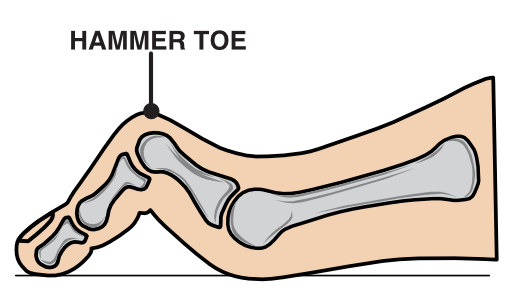
Hammer Toe
A hammer toe is when the proximal interphalangeal joint (shown) bends down. Due to the change in shape this can result in a corn/callous developing on the top and/or tip of your toe. This is most commonly seen in the second toe but can occur in any of the smaller toes. If left untreated can become fixed over a period of time.
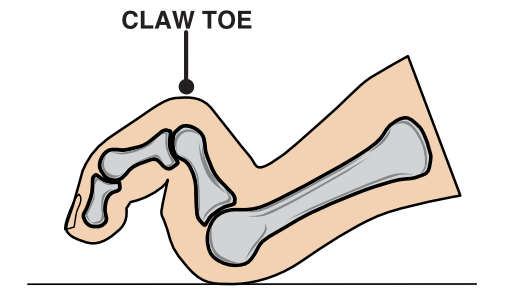
Claw Toe
A claw toe is when the proximal and distal interphalangeal joints bend down (shown). Due to this change in shape, you may experience pain and calluses or corns over the top and/ or tip of your toe. If left untreated, the severity of the deformity can increase over time.
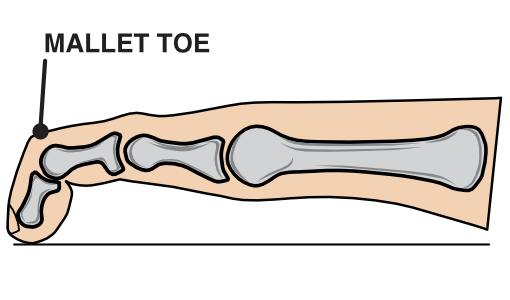
Mallet Toe
A mallet toe is when the distal interphalangeal joint bends down, (shown). Due to this change in shape you may experience pain and calluses or corns over the top and/ or tip of your toe. If left untreated it can become fixed over a period of time.
Overlapping toe
An overlapping toe is often seen alongside a bunion but does not always involve the big toe and can be common in the fifth toe as well. This deformity can lead to discomfort and callous build up over the top of the joints as well as increased pressure between and around the toes.
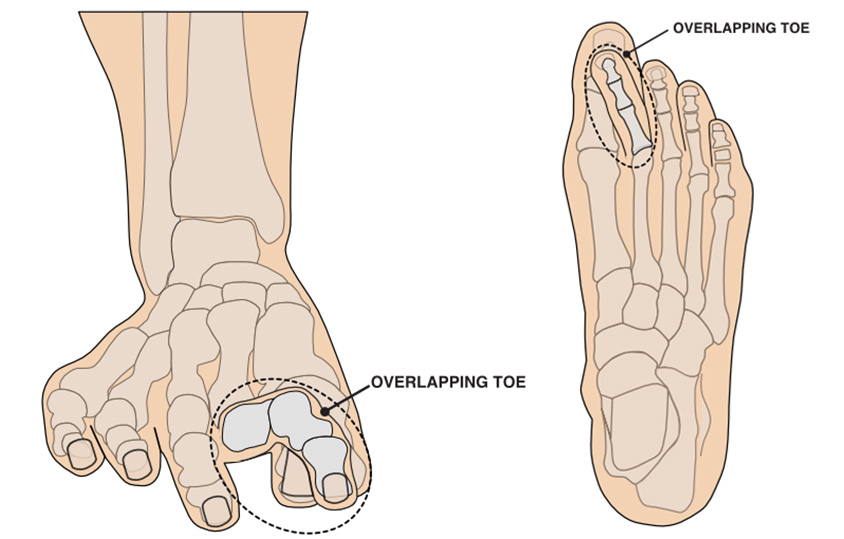
You may experience any or all of the following:
- Pain and callous and/or corns over the top of the joints of the toes
- Deformity in the shape of toe
- Shoes becoming uncomfortable over the toes
- Pain and callous underneath the tip of the toe
- Redness and swelling around the joint
- Stiffness in the joints of the toe
- Difficulty walking
The change in the shape of your toes occurs as a result of an imbalance between the muscles and tendons which hold your toes straight and those that bend the toes. There can be several reasons for these changes:
- Ill-fitting footwear
- Inflammatory conditions (e.g. rheumatoid arthritis)
- Trauma
- Hallux Valgus (Bunions)
- Neuromuscular conditions
- Peripheral neuropathy leading to a muscle imbalance
To improve comfort, you need to relieve the pressure on the toes and there are several ways you can do this yourself.
Making changes to your lifestyle as well as reducing aggravating activities is key to helping your recovery. Only you can do this.
There are a number of things you can try including:
- Rest and raise your foot on a stool when you can
- Put an ice pack (or bag of frozen peas) in a towel on the painful area for up to 20 minutes every 2 to 3 hours
- Wear shoes with cushioned heels and good arch support
- Use insoles in your footwear
- Try regular stretching and foot exercises
- Try exercises which put no pressure on your feet, such as swimming
- Try to lose weight if you’re overweight or obese
These a number of things to try to avoid including:
- Avoid walking or standing for long periods
- Avoid wearing high heels and tight pointy shoes
- Avoid wearing flip-flops or backless slippers
- Avoid walking barefoot on hard surfaces
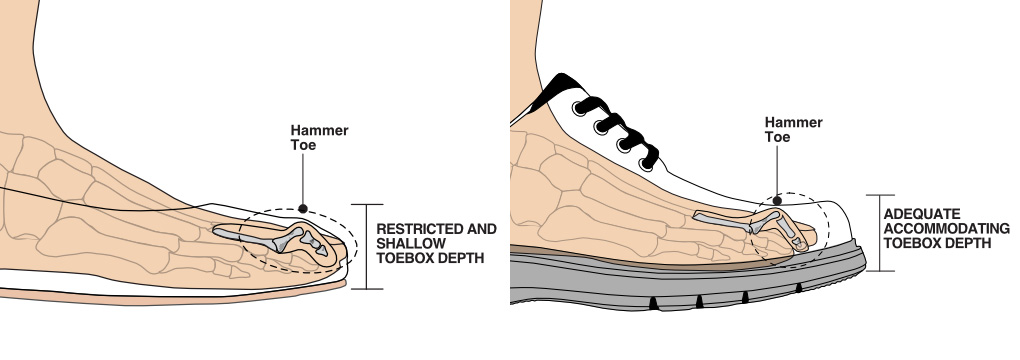
It is important that you choose footwear that is deep enough to accommodate any hammer toe or clawing deformities. It can also be useful to choose a shoe that has a softer material as the upper. Softer materials can mould around the toes more easily than hard patent leathers.
If your shoe is not deep enough, it will rub on the prominent joints causing the surrounding skin to become red, swollen and in some cases the skin can blister or become thickened. Sometimes a fluid filled sac, called a bursa, can develop over the joint. The bursa can also become inflamed and painful.
watch the Footwear Advice Video for more information
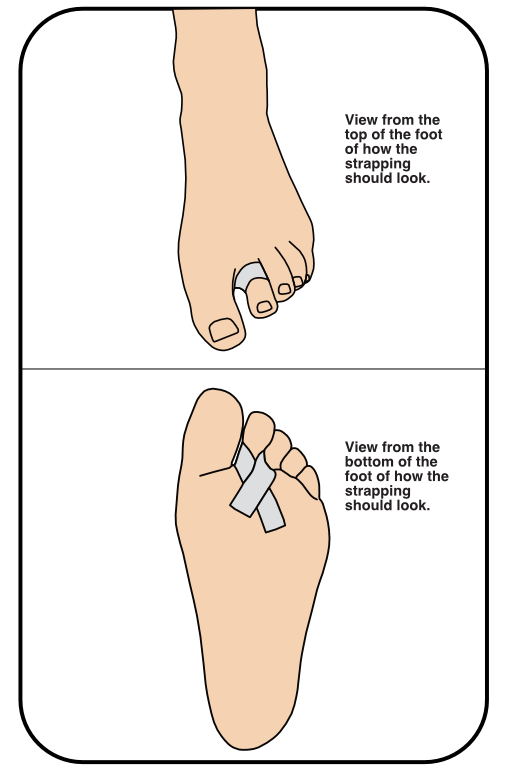
Strapping/taping can be used to help support your toe to help guide improved position and stability. This can be a useful short term treatment that can help reduce your symptoms. The aim of this low dye taping is to help stabilize and heal the plantar plate ligament after a sprain or injury.
The tape used for this is a rigid strapping called zinc oxide tape. It’s available in most pharmacies and can also be bought online.
Taping is only a short term treatment and we recommend it’s used until your pain levels decrease.
We advise that each application of the tape is kept in place for a maximum or 3 to 4 days. You may find that the tape needs to be replaced more frequently in order for it to remain effective.
Before you start it can sometimes be helpful to have your strips of tape pre-cut. To get the correct length of tape you can use your hand as a reference. Starting at the tip of your longest finger run the tape to the base of your palm. This should give you the correct amount or tape. Next cut the tape lengthwise into 2 equal sized pieces. Take one of the pieces and stick it back on the roll for later
Tailor’s Bunion (Bunionette)
What is a Tailor’s Bunion?
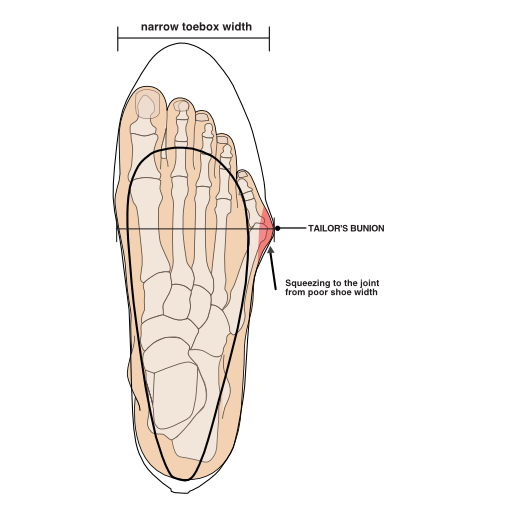
A Tailors bunion is a deformity that causes a bony lump, that can also include soft tissue, to develop around the small toe joint on the outside of your foot. Tailors bunions are not as common as bunions.
The bony lump can make your foot wider, making it more difficult to find footwear that is comfortable. Tight fitting footwear can cause rubbing on the Tailors bunion resulting in your skin becoming red, painful and swollen. In some cases the skin can thicken or even blister. On occasion, a bursa can develop over the bony lump which can become inflamed and painful. A bursa is a small fluid filled sack that is found between the bone and the soft tissue and helps to increase shock absorption and reduce friction.
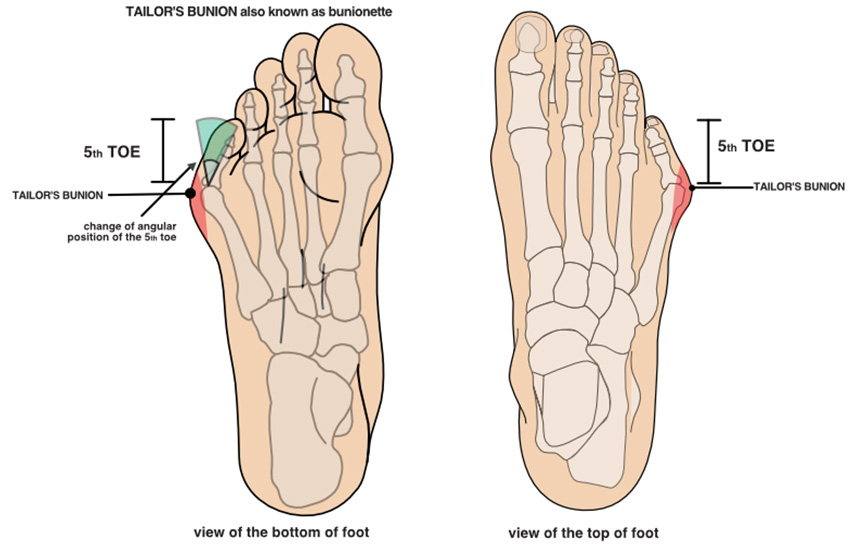
You may experience any or all of the following:
- bony lump on the outside of your foot at the little toe joint
- deviation of the small toe towards the fourth
- toe pain and swelling around the bony lump
- inflamed, swollen or hard skin over the bony lump
- difficulty in finding comfortable fitting footwear
The exact cause is unknown, but it is believed that inherited factors (runs in the family) and the shape of the bones in the feet play a big role in the cause. Footwear is often listed as a contributing factor. Poorly fitting footwear will make your foot more uncomfortable. Footwear that is too tight will put pressure on the joint, bursa and surrounding nerves which will lead to pain.
You may have contributing factors related to a tailor’s bunion (bunionette):
- Previous injuries/trauma to your toe joints
- Hypermobility/flexible joints
- Age
- Inflammatory arthritic conditions (rheumatoid arthritis, Psoriatic arthritis, etc.)
- Tightness in the muscles in the back of your leg
- Neuromuscular conditions (Stroke, Cerebral Palsy, Multiple Sclerosis, Charcot-Marie Tooth Syndrome).
Most peoples’ pain will decrease by following nonsurgical advice that is aimed at easing or removing the pressures caused by the deformity. These measures will not correct or reduce the size or shape of your deformity.
Making changes to your lifestyle as well as reducing aggravating activities is key to helping your recovery. Only you can do this.
There are a number of things you can try including:
- Rest and raise your foot on a stool when you can
- Put an ice pack (or bag of frozen peas) in a towel on the painful area for up to 20 minutes every 2 to 3 hours
- Wear shoes with cushioned heels and good arch support
- Use insoles in your footwear
- Try regular stretching and foot exercises
- Try exercises which put no pressure on your feet, such as swimming
- Try to lose weight if you’re overweight or obese
These a number of things to try to avoid including:
- Avoid walking or standing for long periods
- Avoid wearing high heels and tight pointy shoes
- Avoid wearing flip-flops or backless slippers
- Avoid walking barefoot on hard surfaces
It is important that you choose footwear that is wide and deep enough to accommodate your Tailor’s bunion.
It can also be useful to choose a shoe that has a softer material on the upper. Softer materials can mould around the deformity easier than hard patent leathers.
If your footwear is too narrow it will rub on the Tailor’s bunion causing the surrounding skin to become red, swollen and in some cases become thickened and even blister.
watch the Footwear Advice Video for more information
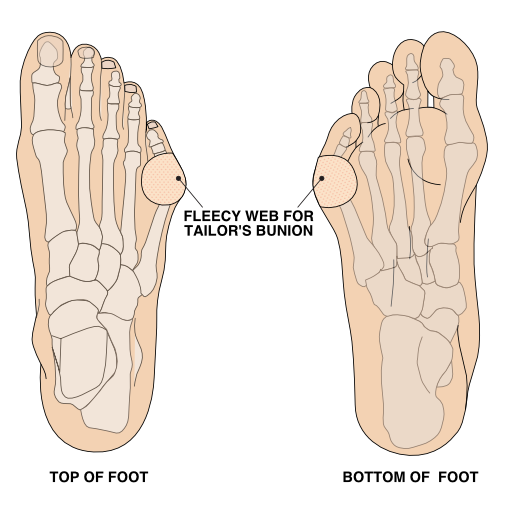
If you find that the skin or bursa overlying the Tailor’s bunion becomes inflamed or blisters, covering the area with a plaster (if skin is broken) or padding (fleecy web/ semi compressed felt) should help to reduce the friction
Pain Activity Ladder
By following the pain activity ladder you can identify activities that you would consider severely painful, moderately painful and mildly irritating and act to change your habits.
The pain scale, most often used in healthcare, measures pain from 0-10 (zero being no pain and 10 representing the worst pain you could imagine).
If you can identify the level of pain you are experiencing, you will find out if you are in the green, amber or red zone. The best way to move down to the green zone is by pacing and spacing your activity.
When you are completing your rehabilitation exercises it is often best to work within the green (and sometimes amber zones depending on what you deem is an acceptable level of pain) both during the exercises and within 48 hours of completing your exercises. If you find yourself in the red zone you are likely pushing yourself too hard and may flare up the pain.
Ankle, Foot and Toe Exercise
The following exercises will help to improve your pain over a period of time. Remember to follow the advice from the Pain Activity Ladder section above.
- Towel stretch
- Intrinsic towel strengthening
- Standing calf stretch
- Intrinsic foot exercise using sports resistance band
- Foot arch exercise using sports therapy ball
- Toe motion exercises