


Remain in the collar and cuff (or polisling) until instructed by your doctor, nurse or physiotherapist.
What Symptoms May I Experience?
- Pain – due to the fracture and/or the soft tissues area the injury
- Stiffness – due to lack of use of the arm
- Swelling – due to the injury and the body’s attempt at healing
- Bruising – due to the injury (can track down the arm and forearm)
- Difficulty with normal daily tasks
What Should I Do To Help These Symptoms?
- Pain – painkillers can be helpful – speak to your pharmacist or GP about appropriate medication.
- Stiffness / swelling / bruising – keep the arm in the collar and cuff (or polisling), unless doing exercises as shown in the next section. Ice packs over the front of the shoulder can also be helpful.
- Difficulty with normal daily tasks – your strength and movement needs to be built up before tackling heavy tasks (e.g. carrying kettles / pots / shopping bags).
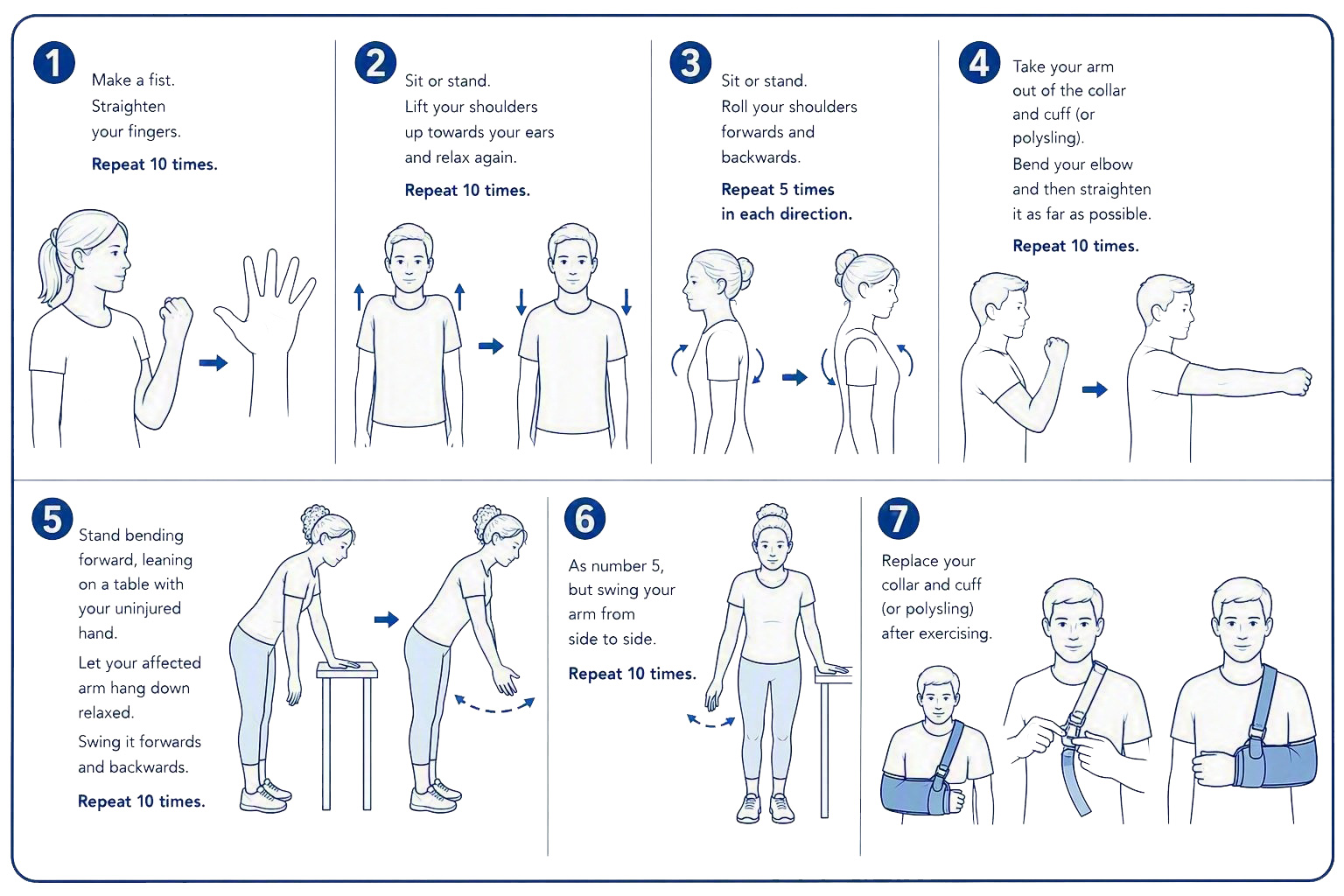
What Exercises Are Useful?
It is important to engage with the physiotherapy team to help regain the strength and movement in your shoulder as soon as possible.
The exercises are designed to increase your movement and strength to prevent further stiffness in the shoulder.
It is normal to feel some discomfort when moving your shoulder initially, but this will improve over time.
Moving your shoulder gently as shown will not prevent your shoulder from healing. Try to do the following exercises 4 times daily.
Will My Shoulder Get Back To Normal?
Your ability to carry out daily tasks will improve with time. You may not gain full function of your shoulder, but many patients improve by 3 months. Further improvements can be seen up to 12-18 months following injury. It is important to continue with your exercises and not give up.
You should not drive until you have recovered good shoulder movement and can safely control a steering wheel.
You can return to work when you feel able to carry out your duties. This may be immediately if have a non-manual job or longer if you do heavy, manual work.
If you feel you need further help and have not been referred to a physiotherapist, contact your GP.
Contact details
Physiotherapy department
Stirling Community Hospital – 01786 434061
Forth Valley Royal Hospital – 01324 566600