

Mum Praises Local Rehab Team Who Helped Her Get Her Life Back
A Scottish mum who spent three months in intensive care after Guillain-Barré syndrome left her completely paralysed is backing calls for everyone in Scotland to have access to the rehabilitation they need.
Lynsey Macdonald, 42, from Denny, Falkirk, was the fittest she had been in years, focussing on getting healthy, when out of the blue she started to feel unwell. Within 12 hours she was paralysed and the medical team placed her on a ventilator to save her life.
“I had Guillain-Barré syndrome, which I’d never even heard of. One minute I was fine and the next minute I was critically ill. At first, the only thing I could move was my eyes. Then I lost even that.
“I was completely locked in. I could hear what was going on around me, but I couldn’t move, I couldn’t speak and I couldn’t communicate. It was terrifying.
“I was in a coma for two weeks and, when I started to come around, I still wasn’t really aware of everything for a long time. I could hear people around me and I knew what was happening, but there was nothing I could do.
“The one thing that kept me going was my daughter. I’m a single mum, which is hard enough without having something like this on top of everything else. I knew I had to keep fighting because I had to get home to her.”
After three months in intensive care, Lynsey was learning to talk again but she remained paralysed. At this point the Specialist Rehabilitation Unit at the Bellfield Centre in Stirling became involved in Lynsey’s recovery.
Lynsey was transferred to the Specialist Rehabilitation Unit at Stirling Health and Care Village where she and her rehabilitation team began setting goals together, starting with things many people take for granted.
She wanted to feed herself, brush her own teeth and do her own hair.
The rehabilitation team adapted equipment to help her regain those everyday abilities. When Lynsey couldn’t grip a toothbrush, they made the handle thicker and secured it to her hand so she could hold it herself.
Four months after she had last been able to do it, Lynsey brushed her own teeth.
Gradually, the goals became bigger. The woman who had arrived at the Bellfield Centre on a stretcher eventually walked out.
“When everything has been taken away from you, being able to do one ordinary thing for yourself means so much.
“Then the goals got bigger. Being alive and having a life are two different things. The team went through everything with me. They saw me arrive on a stretcher, paralysed and needing people to bathe me, and they saw me get all the way to walking out of there.”
Throughout her recovery, Lynsey’s biggest goal was to get home to her daughter. After seven months apart, she is now back home with her. But Lynsey’s rehab journey didn’t end when she got home. The team continued to visit her two or three times a week at first, until she could cope to do things by herself again.
“Those things could be as simple as opening a bottle or cooking a meal. Things I had done without thinking before, I had to learn how to do all over again.
“Then, after about 15 weeks, the community physiotherapy team stepped in and carried on helping me move forward. The team helped me become independent again. They helped me get home to my daughter. They helped me get my life back.”
Now having retrained to get back to work and reunited with her daughter, Lynsey is determined that other people facing life-changing illness should have the same opportunity to rebuild their lives.
She is taking her story to the Scottish Parliament during National Rehabilitation Awareness Week (14–20 September), when the Chartered Society of Physiotherapy (CSP) will host a Right to Rehab exhibition.
Lynsey’s experience comes as the Right to Rehab Coalition warns that access to rehabilitation across Scotland remains inconsistent, delayed or unavailable.
In 2024/25, more than 720,000 hospital bed days in Scotland were occupied by patients who were medically ready for discharge, at a cost of at least £440 million in hospital bed costs alone.
The Right to Rehab Coalition says better access to rehabilitation could help people recover independence and leave hospital when they are medically ready, but services remain underfunded and fragmented across health, social care and the third sector.
Kenryck Lloyd-Jones, Public Affairs and Policy Manager for Scotland at the Chartered Society of Physiotherapy, said:
“Lynsey’s story shows what rehabilitation can make possible, not just helping someone recover movement, but helping them reclaim their independence, their role as a parent and their life.
“But access to rehabilitation in Scotland remains too inconsistent. Where you live, the services available and when you can access them should not determine whether you get the chance to rebuild your life.
“During National Rehabilitation Awareness Week, we are asking MSPs to back our calls to action, and help make the right to timely, high-quality rehabilitation a reality for everyone who needs it.”
Professor Paul Cameron, Director of Allied Health Professionals (AHPs) at NHS Forth Valley, said:
“We are delighted to receive such positive feedback from Lynsey on the care and support she received from staff in the Specialist Rehabilitation Unit at the Bellfield Centre in Stirling.
“As a physiotherapist, I recognise the importance of high-quality rehabilitation services and see first-hand the difference these can make to the lives of people of all ages. We are very proud of the services and support we provide in NHS Forth Valley and it’s great to hear how much these services are valued by local patients and their families.”
Senior Charge Nurse, Craig Finlayson and AHP Team Leader, Linda Stevenson who supported Lynsey through her recovery at the Specialist Rehabilitation Unit at the Bellfield Centre, said:
“The NHS Forth Valley Specialist Rehabilitation Service is a nurse and Allied Health Professional led rehabilitation unit providing specialist care for patients with complex rehabilitation needs. We frequently work with people who have sustained life changing injuries, as well as those living with a wide range of neurological conditions.
“We are delighted to be able to offer the population of Forth Valley such a person-centred, goal focussed rehab service. Lynsey’s journey is a great example of the difference rehabilitation can make in giving life back, optimising function and adding life to years. It was a real privilege to share that journey with her.”
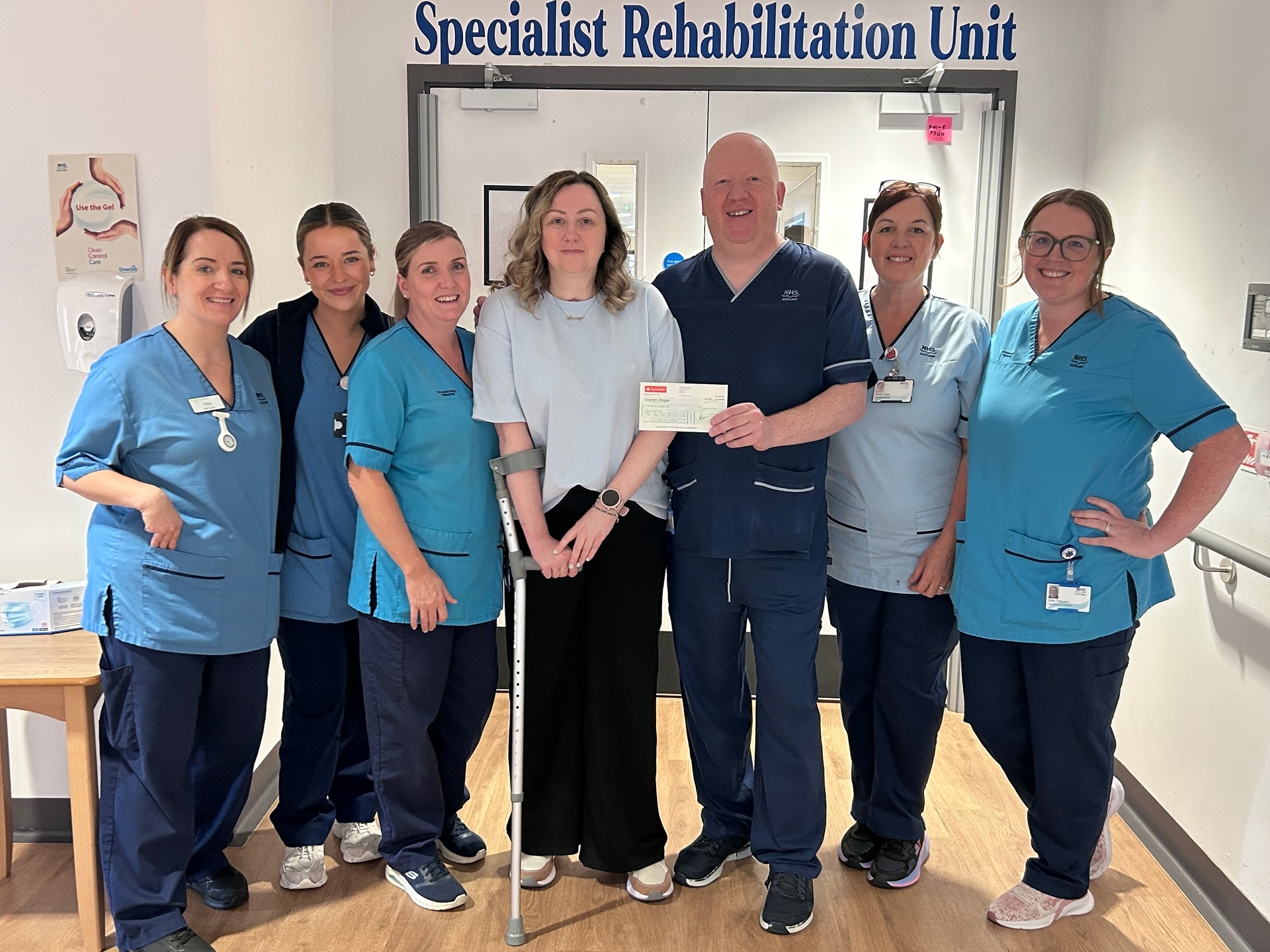
Lynsey, a trained massage therapist is not yet back at work but has just completed an award in education to enable her to teach. With her colleagues Lynsey has recently organised a fundraising event with her colleagues which raised £2,000 for the Bellfield Centre.
She now hopes that by sharing her story with MSPs, other people facing devastating illness or injury will have the opportunity to regain the level of independence she fought so hard to recover.
On speaking about the Specialist Rehabilitation Team of physiotherapists, nurses, occupational therapists, psychologists, dieticians, speech and language therapists, and therapist assistants, Lynsey says,
“I feel like I have so many bonds there now. They worked with me every day because they knew how much I wanted to get home, and what I had to get home for.”