

In this section:
Hallux Valgus (Bunions) Hallux Limitus/Rigidus (Osteoarthritis) SesamoiditisPain Activity Ladder Ankle, Foot and Toe Exercise Footwear Advice Video
Hallux Valgus (Bunions)
What is Hallux Valgus?
Hallux valgus or bunions is the most common condition affecting the forefoot (front of the foot) in adults. It affects around one in five adults and is more common in women than men. It may affect one or even both of your feet. Usually one foot is affected worse than the other.
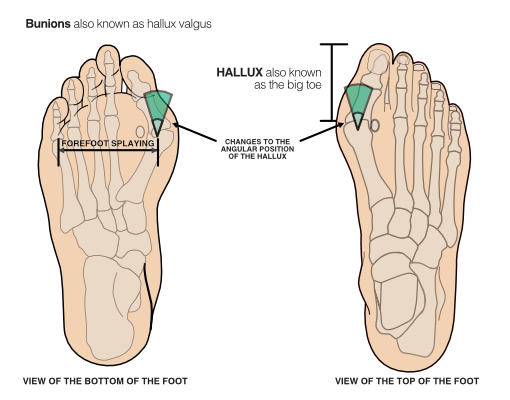
Hallux Valgus is a deformity which causes a bony lump to develop on the inside of your foot at the big toe joint better known as a bunion. The formation of a bunion can increase the stress on the tendons causing your big toe to deviate towards the second toe.
Many people who have bunions have no pain and require no treatment, however some can develop significant pain and deformity. In both cases finding comfortable footwear can be a problem depending on the severity of the bunion.
The bunion can make your foot wider, making your footwear tighter. Tight fitting footwear will cause rubbing and friction over the bunion causing the skin to become red and swollen. In some cases the skin can thicken or even blister. A small fluid filled sack called a bursa may develop over the bunion which can be inflamed, swollen and painful. The severity of the pain will depend on how much pressure there is from your footwear. A bursa develops as a means of protection and shock absorption to a particular area that is having a lot of stress and pressure applied to it.
You may experience any or all of the following:
- Bony lump on the inside of the big toe joint
- Deviation of the big toe towards the second toe
- Pain, stiffness and swelling of the big toe joint
- Inflamed, swollen or hard skin over the bunion
- Difficulty in finding footwear that fits comfortably
- Deformity of the smaller toes
Although hallux valgus a very common condition the cause is unknown. It is believed that inherited factors (runs in the family), the shape of the bones in your feet and footwear are well known causes. Ill-fitting footwear can cause your bunions to be more uncomfortable and may increase the risk of developing problems in the future.
You may have contributing factor related to Hallux Valgus (Bunions):
- Previous injuries/trauma to your toe joints
- Hypermobility/flexible joints
- Age
- Inflammatory arthritic conditions (Rheumatoid Arthritis, Psoriatic Arthritis, etc.)
- Tightness in the muscles in the back your leg
- Neuromuscular conditions (Stroke, Cerebral Palsy, Multiple Sclerosis, hereditary motor and sensory neuropathy, etc.)
- Certain activities that place increased stress through your big joint (walking, running, sporting activity etc.)
Your pain should start to improve by following the advice that is aimed at reducing the pressures around the deformity. These self-help measures will not correct or reduce the size or shape of the deformity.
Making changes to your lifestyle as well as reducing aggravating activities is key to helping your recovery. Only you can do this.
There are a number of things you can try including:
- Rest and raise your foot on a stool when you can
- Put an ice pack (or bag of frozen peas) in a towel on the painful area for up to 20 minutes every 2 to 3 hours
- Wear shoes with cushioned heels and good arch support
- Use insoles in your footwear
- Try regular stretching and foot exercises
- Try exercises which put no pressure on your feet, such as swimming
- Try to lose weight if you’re overweight or obese
These a number of things to try to avoid including:
- Avoid walking or standing for long periods
- Avoid wearing high heels and tight pointy shoes
- Avoid wearing flip-flops or backless slippers
- Avoid walking barefoot on hard surfaces
It is important that you choose footwear that is wide and deep enough to accommodate the bunion and any lesser toe deformities. It can also be useful to choose a shoe with a softer material on the upper/ top section around the lacing area.
Softer materials can mould around deformity easier than hard patent leathers. If your shoe is too narrow it will rub on the bunion causing the surrounding skin to become red, swollen and in some cases thickening or blistering.
watch the Footwear Advice Video for more information.
Hallux Limitus/Rigidus (Osteoarthritis)
What is Hallux Limitus/Rigidus?
Hallux Limitus/Rigidus is a gradual condition where the movement at the big toe joint decreases with time. In the early stage, the movement at the joint will have only reduced a little, but as the problem advances the movement becomes less and eventually the big toe joint becomes stiff. The protective tissue around the joint called cartilage can become damaged causing extra bone to form around the joint. This extra bone will restrict movement and will cause pain when walking.
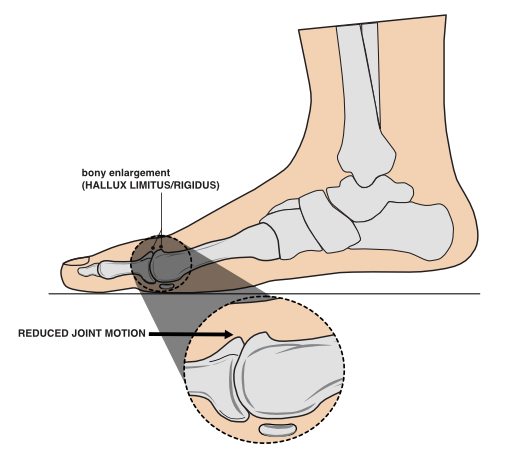
Hallux Limitus/Rigidus is when there is change to the bone that prevents normal movement of the big toe joint.
These changes can be minor with a slight reduction of movement and is known as Hallux Limitus. Hallux Rigidus is when there is a significant reduction in movement and some cases there can be a complete loss of motion at the big toe joint.
Changes to the big toe joint can affect the ability of your foot to remain stable during walking. This can result in increased pressure through your fore foot and you may develop a bony enlargement on the top of the big toe joint.
You may experience any or all of the following:
- Pain, usually at the top of your big toe joint that worsens with weight bearing activity
- Difficulty bending your big toe
- A bony lump/ soft tissue swelling on the top of you big toe joint that may hurt when it rubs against your shoe
- Numbness or tingling if the bony lump is pressing on your nerves
There is no specific cause of Hallux Limitus/Rigidus but there are a number of things that can increase your risk. The most common cause is trauma as this can lead to arthritic changes within the big toe joint. Unusual foot anatomy can also increase your risk. The length of your big toe can affect the function of the joint.
You may have contributing factor related to Hallux Limitus/Rigidus (Osteoarthritis):
- Acute injury e.g. stubbing your toe
- Repetitive trauma with movements that will increase load through the big toe joint i.e. squatting
- Changes in the shape of the bones in your foot that can lead to osteoarthritis in the big toe joint
- Inflammatory diseases e.g. rheumatoid arthritis, etc.
- Unsupportive/ ill-fitting footwear
- Family history
Unfortunately there is no quick or easy fix and your symptoms will not improve overnight. Making simple changes to you lifestyle and footwear choices can help improve your hallux Limitus/Rigidus pain.
Making changes to your lifestyle as well as reducing aggravating activities is key to helping your recovery. Only you can do this.
There are a number of things you can try including:
- Rest and raise your foot on a stool when you can
- Put an ice pack (or bag of frozen peas) in a towel on the painful area for up to 20 minutes every 2 to 3 hours
- Wear shoes with cushioned heels and good arch support
- Use insoles in your footwear
- Try regular stretching and foot exercises
- Try exercises which put no pressure on your feet, such as swimming
- Try to lose weight if you’re overweight or obese
These a number of things to try to avoid including:
- Avoid walking or standing for long periods
- Avoid wearing high heels and tight pointy shoes
- Avoid wearing flip-flops or backless slippers
- Avoid walking barefoot on hard surfaces
It is important to be aware that your big toe joint may not bend enough to accommodate being in certain shoes. High heeled shoes in particular will place further stress on the big joint and the soft tissues around it.
Wearing a shoe with a stiffer sole and/or a curve at the forefoot area can be more comfortable. The curve at the front of your shoe is called a toe spring and helps to reduce the stress in the joints and soft tissues in your feet when walking.
watch the Footwear Advice Video for more information.
Sesamoiditis
What is Sesamoiditis?
Sesamoiditis is where there is inflammation and pain in sesamoid bones and surrounding soft tissues. Pain is felt under the big toe joint. Young active people are most commonly affected. While sesamoiditis pain can come and go it can cause great discomfort especially when walking.
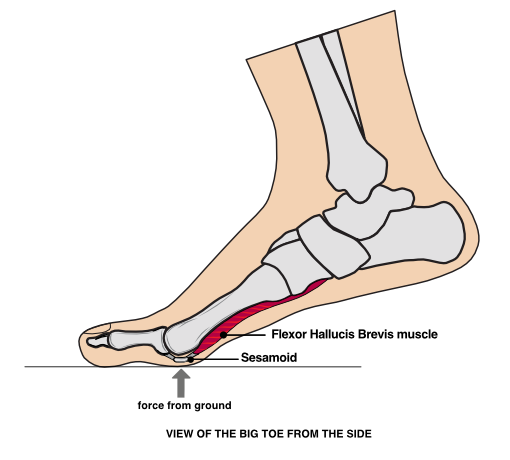
The sesamoid bones are two small bones that sit within one of the tendons that runs underneath your big toe joint. They act as a pivot for the tendons that bend the big toe. There is a medial sesamoid (nearest the inside of the foot) and a lateral sesamoid (nearest the second toe) The medial sesamoid tends to be the one that causes discomfort.
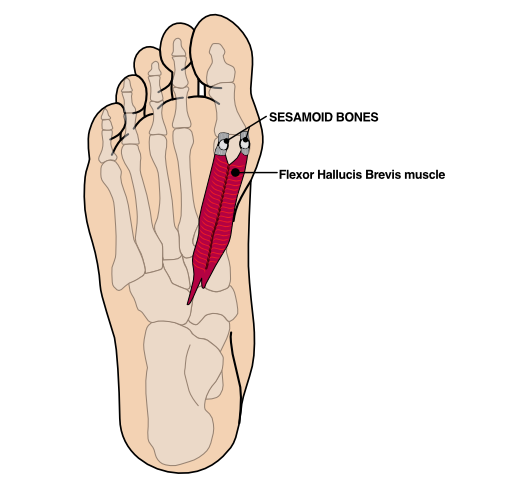
You may experience any or all of the following:
- Pain underneath your big toe when walking, especially when your big toe bends
- Pain on weight bearing activity
- Pain eases with non-weight bearing activity
- Pain on direct pressure of area
- Swelling
In most cases Sesamoiditis develops as a result of sudden changes in activity or how often and how much load is being placed through the big toe joint. This will cause small injuries and lead to injury.
You may have contributing factor related to Sesamoiditis:
- Sudden increase in weight
- Wearing unsupportive footwear such as shoes or sandals
- Impact/ trauma -tired/ overused feet
- Repeated loading from sports
- Sudden increased activity such as starting a new job or leisure activity
- Sudden bending of you big toe
- Regular walking wearing high heels
- Osteoarthritis
- Osteoporosis
- Large sesamoid bones
- High arched feet
- Flat feet
Unfortunately there is no quick or easy fix and your symptoms will not improve overnight. Making simple changes to you lifestyle and footwear choices can help improve your sesamoiditis pain.
Making changes to your lifestyle as well as reducing aggravating activities is key to helping your recovery. Only you can do this.
There are a number of things you can try including:
- Rest and raise your foot on a stool when you can
- Put an ice pack (or bag of frozen peas) in a towel on the painful area for up to 20 minutes every 2 to 3 hours
- Wear shoes with cushioned heels and good arch support
- Use insoles in your footwear
- Try regular stretching and foot exercises
- Try exercises which put no pressure on your feet, such as swimming
- Try to lose weight if you’re overweight or obese
These a number of things to try to avoid including:
- Avoid walking or standing for long periods
- Avoid wearing high heels and tight pointy shoes
- Avoid wearing flip-flops or backless slippers
- Avoid walking barefoot on hard surfaces
If high heels or other shoes are causing an increase in your discomfort, you should avoid these and opt for something more supportive and comfortable. Soft, cushioned, lower heeled shoes with a stiff toe spring should help to reduce the bending of your big toe which can help to reduce your symptoms.
Shoes that have flexible soles generally offer the foot less support and can increase the stress in soft tissues within your foot. If you have shoelaces make sure they are tied appropriately. Avoid wearing hard, flat or unsupportive shoes.
watch the Footwear Advice Video for more information
To help cushion and offload the sesamoids, a pad can be placed into your shoe or directly on the foot.
The padding is usually made of semi-compressed felt.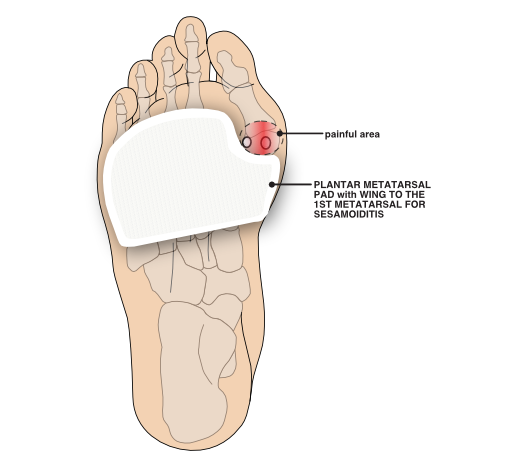
Pain Activity Ladder
By following the pain activity ladder you can identify activities that you would consider severely painful, moderately painful and mildly irritating and act to change your habits.
The pain scale, most often used in healthcare, measures pain from 0-10 (zero being no pain and 10 representing the worst pain you could imagine).
If you can identify the level of pain you are experiencing, you will find out if you are in the green, amber or red zone. The best way to move down to the green zone is by pacing and spacing your activity.
When you are completing your rehabilitation exercises it is often best to work within the green (and sometimes amber zones depending on what you deem is an acceptable level of pain) both during the exercises and within 48 hours of completing your exercises. If you find yourself in the red zone you are likely pushing yourself too hard and may flare up the pain.
Ankle, Foot and Toe Exercise
The following exercises will help to improve your pain over a period of time. Remember to follow the advice from the Pain activity ladder section above.
- Towel stretch
- Intrinsic towel strengthening
- Standing calf stretch
- Plantar fascia wall stretch
- Standing double heel raises
- Plantar fascia loading
- Intrinsic foot exercise using sports resistance band
- Foot arch exercise using sports therapy ball
- Toe motion exercises
- Cold therapy