


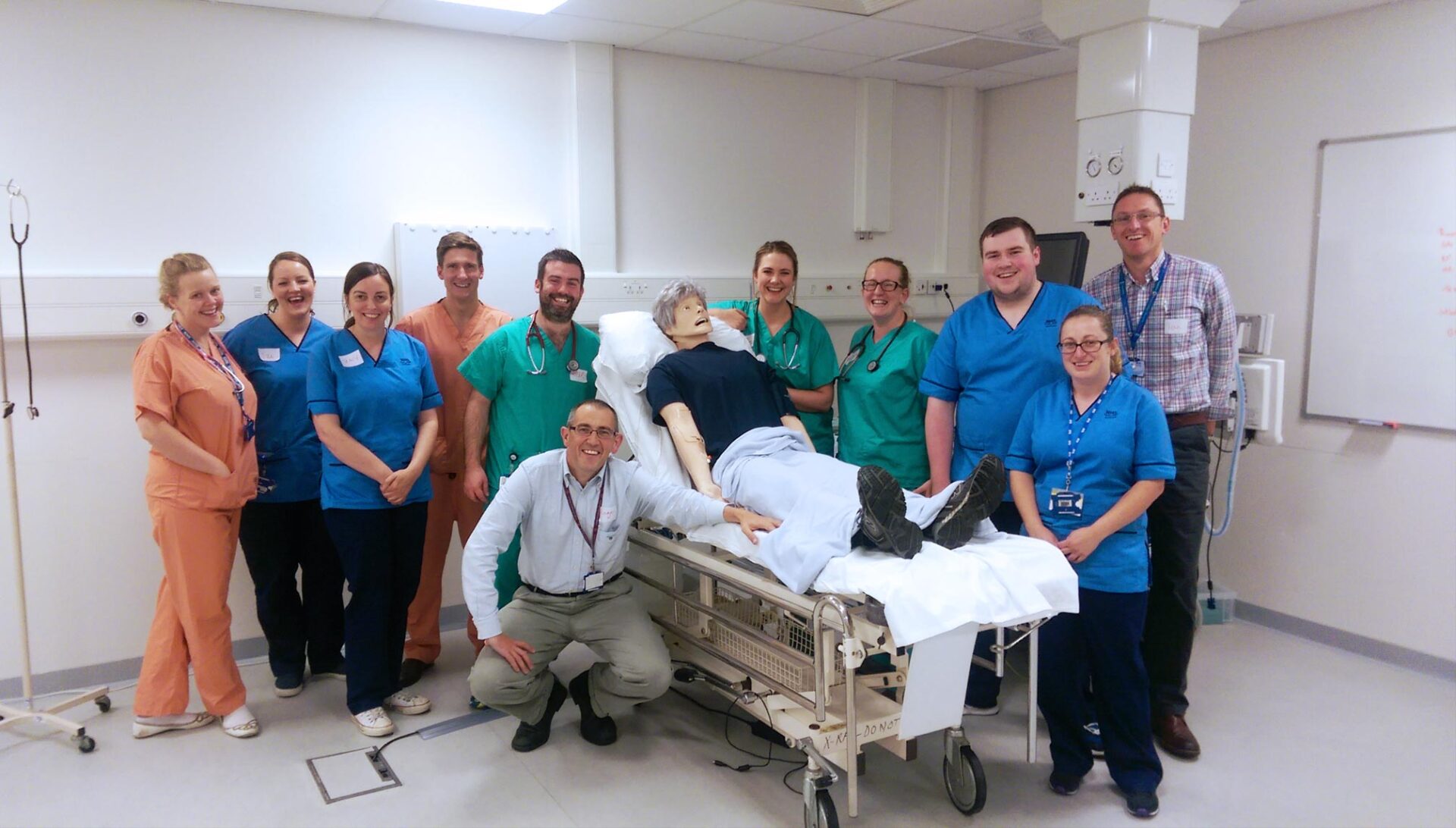
New Research Shows Simulation Can Help Address Healthcare Challenges
A newly published article in BMJ Leader highlights how an innovative approach to simulation in NHS Forth Valley is being used to address complex healthcare challenges – moving beyond simulation technology’s traditional role in clinical training.
The article, “From Escalation to Emergence: NHS Forth Valley and the Quiet Power of Transformative Simulation,” describes how NHS Forth Valley has embedded simulation not only as a training technique, but as a leadership and learning tool. The work shows how simulation can support cultural change, decision-making and learning in healthcare services.
The research from the University of Greenwich documents how simulation was used to explore difficult issues, strengthen shared understanding, and support coordinated action across services.
While simulation is often associated with clinical training, Transformative Simulation takes a different approach. It uses simulation as a technique which enables NHS staff and patients come together to share insights on how NHS services actually function.
Scenarios explored in the paper include:
- Emergency response pathways in GP practices
- Delays in community equipment provision
- Recruitment and workforce development
- Supporting international medical graduates
- Responding to deteriorating patients in acute hospital settings
These immersive simulations created safe spaces for open dialogue and reflection, leading to tangible changes in policy, practice and organisational culture.
The paper features contributors from NHS Scotland, academic and health institutions across the UK, healthcare industry partners, and the Association for Simulated Practice in Healthcare (ASPiH), which supported the work through its Transformative Simulation initiative.
Professor Sharon Weldon, Professor of Healthcare Simulation and Workforce Development at the University of Greenwich and President of ASPiH, said: “What stood out to me was the quiet courage of the executive and clinical leaders at NHS Forth Valley. As a nurse and workforce researcher, I’ve seen many programmes and frameworks that claim to deliver transformation. What was different here was the willingness of leaders to try a different approach and engage honestly with complexity.
“In doing so, they created the conditions for more human, connected and compassionate leadership – even under pressure.”
Dr Julie Mardon, Clinical Director of Integration and Simulation Lead at NHS Forth Valley, added: “Simulation gives us a way to work through complex issues safely and collectively. It helps teams unpick challenges through shared understanding and action. It’s not just something we do – it’s becoming part of how we lead.”
As healthcare systems across the UK and internationally face greater workforce, safety and increasing complexity, the authors suggest that Transformative Simulation offers a practical, scalable way to support leadership, integration and learning – without adding further burden to frontline staff.
Additional Information
The Scottish Centre & Clinical Human Factors in Forth Valley Royal Hospital is NHS Forth Valley’s state-of the-art multi-professional training facility and the only high-fidelity simulation centre in Scotland.