


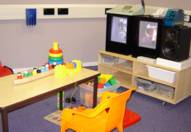
 Most of our children are seen by appointment at our Audiology Departments within the Forth Valley Sensory Centre, or at Stirling Health & Care Village. Our regular clinics at the Forth Valley Sensory Centre mean that some children can be seen without the pressures of a typical hospital waiting room environment.
We offer a wide range of tests for children and babies from birth. Please see our audiology tests page for more information on individual tests, and links to video clips showing some of our tests being carried out. Our consultant paediatrician, Dr Sam Welham, is often present at appointments. They are involved in the medical aspects of the care for hearing impairment children.
The children can be having so much fun, they have no idea that they are also having their hearing tested. We pride ourselves when the children have enjoyed themselves so much that they don’t want to go home.
Children with Hearing Loss
We share information and work closely with other professionals in a multi disciplinary team (with appropriate consent), to be able to provide support to children and families that are affected by childhood hearing loss.
Many of the professionals in the multi agency team are members of our CHSWG (Children’s Hearing Services Working Group).This is a group, which meets regularly to discuss future developments of the supporting service available in Forth Valley. Parents of children with hearing loss are welcome to join this group – please ask for more information from the Audiology Services Manager if you would be interested in knowing more.
No specific children are discussed at CHSWG meetings. For some children however, it is useful to have an arrangement to meet with several professionals at the same time – we call these appointments MASP (Multi Agency Support Plan) meetings. These are organised through Audiology.
Tips for keeping hearing devices on young children
- Ear moulds must fit properly to keep the hearing aids in the child’s ears. Young babies may need new ear moulds every few weeks. Contact your audiologist when the hearing aids start to whistle or when the ear moulds start to slip out with a light tug.
- Hearing aids can be worn all day, even during naps (except for water play). This is necessary for brain, language and social development.
- Ensure the hearing aid battery door locks are in place at all times.
- Keep a hearing aid storages box or pouch in a place you can always find it, such as next to the nappy changing table, so you always know where the hearing aids are and they can be put on and off easily.
- It’s typical for your baby to go through a ‘pulling off their hearing aids’ stage. A hearing aid retention accessory can help with this. Always replace them if they have been pulled out.
- When your child pulls off their hearing aids, be calm and try to maintain a neutral facial expression. If your child pulls off a hearing aid, smile and calmly say, “Hearing aids on! [Child’s name] can hear mummy now”, then distract them with another activity, such as peek-a-boo.
- At 2 years old children may demonstrate their independence by taking off their hearing aids. Continue to be persistent.
- Only adults should take off the hearing aids however at age 2 parents can model for your child how to ask for help (“ears off please?”)
- This provides the opportunity to ask why he wants the hearing aids removed. Is it too noisy? If so you can model moving away from the noise. Is he tired? If so he can help you put the hearing aids in the hearing aid storages box or pouch before his nap. Does he want your attention? Take a minute to help him begin to learn how to put his own hearing aids on and then offer to read him a story.
- Responding to a hearing aid removal during a tantrum is a challenge. The consistent message in your response should be that the hearing aids will go back on.
- At 3 years old your child may take off the hearing aid and take it apart to have a close look at each of the parts. With one hearing aid still in, name for each of the parts and describing how they work. Emphasise the importance of wearing them.
- If interested involve your child in their listening checks, e.g. they could puff the condensation from their tubing.