


The proper name for women’s outer genitals is the vulva. Just like any other part of the body, women’s vulvas come in all shapes and sizes.
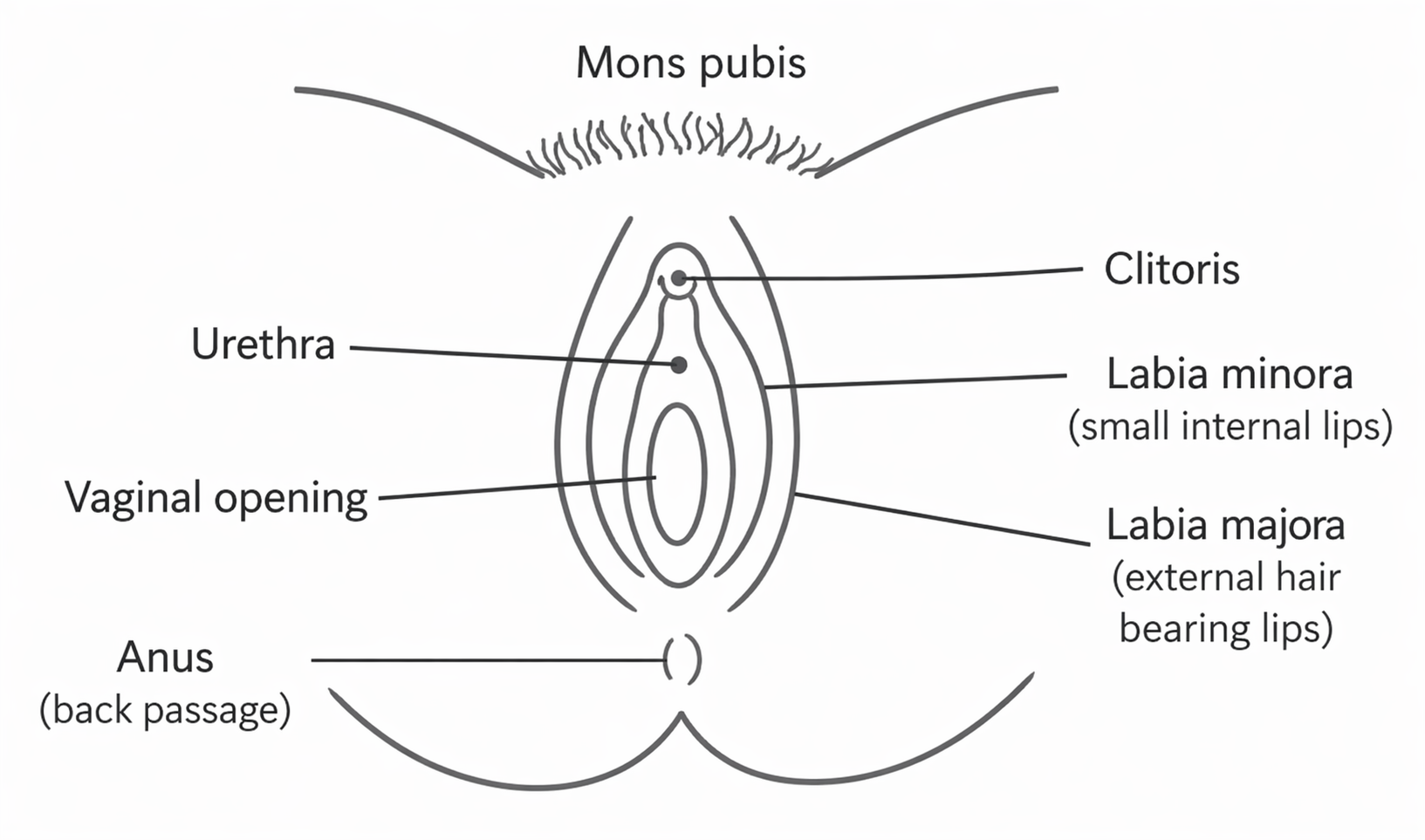
Pubic hair
Pubic hair is the hair that grows around the genital and anal regions. It varies in colour, texture, length and thickness and often extends up the front or back or onto the thighs. It can be straight or curly. Pubic hair provides protection and cushioning to your genitals, and transmits sensation. Some people choose to get rid of their pubic hair for fashion or cultural reasons. Shaving, hair removal cream and waxing can irritate the skin and when the hair starts to grow back you can get ingrown hairs, stubble, or spots.
Clitoris
At the top of the labia minora, there is a fold of skin called the clitoral hood. This connects to the tip of the clitoris. The clitoris extends internally (inside) and is full of nerve endings, 15,000 of them, and the tip of the clitoris is usually the most sensitive area on the vulva and is the only organ on the entire body whose sole purpose is sexual arousal.
Labia Majora and Labia Minora
Women have two sets of labia: the labia majora (outer labia) and the labia minora (inner labia), which sit inside the outer labia. There are lots of other names for the labia minora. You might call them flaps, folds or lips but, whatever you call them, the labia minora have a very important function. They protect the vagina and are full of nerve endings that provide sensation and lubrication during sex.
About half of all women have labia minora that are longer than the labia majora. In addition, exact symmetry of the labia is rare. They come in all shapes, sizes, colours and textures. All these variations are completely healthy and normal. The labia minora change during puberty and often become more prominent in appearance. This is completely normal, like all the other changes that take place during puberty. They will continue to change throughout your life because of hormonal changes and age. If you develop a new mole, lump or cyst on your labia, it is a good idea to see your doctor to have it checked out.
Urethra
The urethra is the urinary opening, the tiny opening where you pass urine (pee) from.
Vagina
The vagina is the passage between the uterus and the external genitals. It is only one part of the vulva, but many people don’t know that there’s a difference between them and mistakenly call the entire outside part of women’s genitals the vagina. The only part of the vagina that’s visible from the outside is the opening. Most of the vagina is actually on the inside and it leads all the way up to the cervix (the neck of the womb where you will have ‘smears’ from when you reach 25).
Other people’s view
It is not acceptable for anyone (a sexual partner, your mum, your friend, a beauty therapist or anyone else) to pass judgement on your vulva. We are all different and healthy vulvas come in a range of sizes and shapes. If someone says something to you about your genitals, they might only have seen vulvas in magazines or pornography. Lots of images in the media are photoshopped to make women’s bodies look different from the reality. This creates a false image of what is considered normal or desirable. Similarly, some people may make the wrong assumption that everyone’s vulva looks the same. Try not to worry about what they have said. Think about the level of respect and trust you expect from a sexual partner and the people in your life.
Changing the way your vulva looks
Some people are so concerned about the appearance of their vulva that they seek advice from their doctor hoping to change the appearance of their vulva. Healthcare professionals are used to answering all kinds of questions about labia and vaginas. You can talk through everything, and it is confidential.
There is an operation called a labiaplasty, a surgical procedure which aims to alter the labia minora and/or labia majora. It usually involves removal of part of the labia under general anaesthetic and takes about one to two hours. You often need a week to recover from this surgery. The risks of the surgery are excessive bleeding at the time of the surgery, infection of the stitches after the surgery, ‘opening up’ of the stitches, scarring of the tissues at the operation site, lifelong pain in the vulval region and loss of sensation of the skin left behind due to nerve damage during the surgery.
Due to these potential complications, labioplasty is not offered in the NHS for cosmetic reasons. Similarly, due to female genital mutilation (this is a practice performed on girls where the genitals are altered or removed for non-medical reasons), it is illegal to deliberately cut, injure or change the vulva. However, it may be required if your doctor finds an abnormality such as a cyst or lesion that needs removed.