


The shoulder is made up of three bones: the scapula (shoulder blade), the humerus (upper arm bone) and the clavicle (collarbone). The part of the scapula that makes up the socket of the shoulder joint is called the glenoid. The ball and socket joint where the glenoid (scapula) and the humerus is the shoulder (Glenohumeral) joint.
There is another small joint just above the shoulder called the acromioclavicular joint. This is where your collar bone meets the shoulder blade. Osteoarthritis can affect either of these joints.
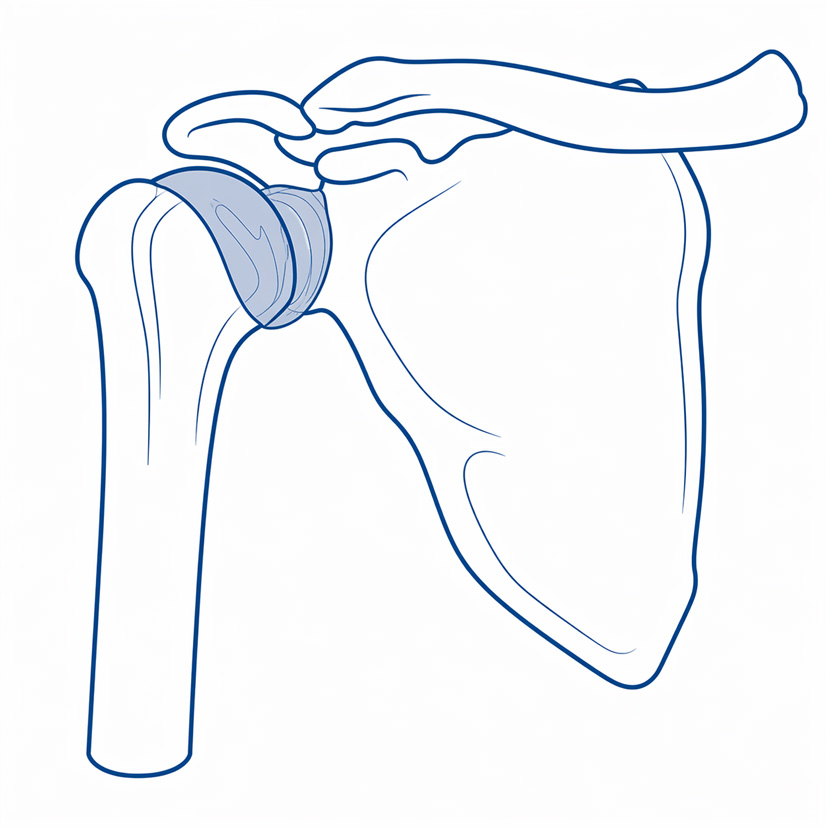
Arthritic shoulder joint
When a joint develops osteoarthritis some of the cartilage covering the joint surfaces can gradually roughen and become thin. The bone underneath the cartilage then reacts by growing thicker and becoming broader, which can result in pain, swelling and restricted joint movement.
Most of the time there is no obvious reason for arthritis. It can develop as part of the natural ageing process, due to an injury, underlying inflammatory joint disease such as rheumatoid arthritis or a shoulder tendon problem (rotator cuff). People with underlying neurological problems may also be affected.
Symptoms of shoulder osteoarthritis
The main symptoms of osteoarthritis in the shoulder are pain and stiffness around the shoulder joint and upper arm.
- Pain may be worse when you move the joint or towards the end of the day.
- You may find your joints become stiff if you have been sitting for a while or in the morning after sleep. This often improves quickly when you get up and start moving.
- Having stiffness in the shoulder may lead to less movement which can affect your normal daily activities. You may notice some grating or crackling sounds when you move. This is known as crepitus.
These symptoms can vary depending on what activities/ tasks you’ve been doing and how long you’ve been doing them. Symptoms can also vary for no obvious reason and you may find you have phases of pain that last a few weeks or months and other periods of time where they is very little or no pain.
How common is shoulder osteoarthritis
Osteoarthritis is not common under the age of 50. It can affect any joint but is more likely in weight-bearing joints such as the hip or knee. The shoulder is the third most common large joint to be affected by osteoarthritis.
What causes shoulder osteoarthritis?
There are various reasons that could cause someone to develop shoulder osteoarthritis. These can include:
- Age: After the age of 60 we are more likely to develop natural ageing of our joints
- Gender: Osteoarthritis, in general, is more common in females
- History of injury: Any previous shoulder dislocations or fractures (Broken bone) near the joint
- Occupation: Those who have had more physically demanding jobs such as those working in construction
- Sport: Those who have participated in overhead or repetitive sports, such as tennis may also be more likely to develop wear and tear
We don’t always know why certain people develop osteoarthritis. Our understanding of it and research in this area is continually developing.
Another factor that may have an impact on your symptoms is the weather. Often changes in weather for example damp, wet weather may increase your joint pain.
What can help with shoulder osteoarthritis?
Osteoarthritis can develop over time in the shoulder however you may not have any symptoms. There is no cure for osteoarthritis. It is a long term condition but that doesn’t mean nothing can be done to help with the symptoms.
X-rays aren’t routinely used to diagnose osteoarthritis. As we get older we expect to see age related changes on x-ray, but these changes may not relate to your level of pain.
Pain activity ladder
By following the pain activity ladder you can identify activities that you would consider severely painful, moderately painful and mildly irritating and act to change your habits.
The pain scale, most often used in healthcare, measures pain from 0-10 (zero being no pain and 10 representing the worst pain you could imagine).
If you can identify the level of pain you are experiencing, you will find out if you are in the green, amber or red zone. The best way to move down to the green zone is by pacing and spacing your activity.
When you are completing your rehabilitation exercises it is often best to work within the green (and sometimes amber zones depending on what you deem is an acceptable level of pain) both during the exercises and within 48 hours of completing your exercises. If you find yourself in the red zone you are likely pushing yourself too hard and may flare up the pain.
Pacing and spacing
Pacing and spacing methods can help you manage your pain better.
Pacing is the term used for breaking down an activity or task. This can be done by taking regular breaks. Prioritising daily activities can also help. This can prevent “over stimulating” your pain system.
When completing challenging tasks or activities, it may be useful to set a “baseline”. This is the amount you can manage on a good or bad day without increasing your symptoms. Therefore, you can plan rests and set achievable goals.
Lifestyle adaptions
With any ongoing conditions, you may need to make some changes to your regular activities to make life easier. Here are some suggestions:
Non-slip bat mats, rails, bath boards or seats may make getting washed easier. If you struggle to get on and off the toilet a raised toilet seat or grab rail may be of use. Consider the layout of your toiletries and avoid having to stretch to reach items.
When drying hair you could try supporting your arm on a table if you are bothered with overhead activity and struggle to hold the weight of the hairdryer.
Getting dressed is easier in a seated position. There are various tools on the market that may help with dressing for example a long-handled shoe horn.
Try to keep items that you use regularly within easy reach. Consider sitting to prepare food, a perching stool or your kitchen table may be helpful.
Try not to overfill pots or kettles as this will make them heavier to lift. It’s worth considering alternate appliances if you continue to struggle, for example, a kettle tipper or a two-handled saucepan.
If you are having difficulty using cutlery or utensils, you could try making them easier to grip by adding extra padding. You can also buy specialist cutlery with large handles.
If you have one side that is painful try to avoid sleeping on the affected side especially with neck, shoulder or hip pain. You might find it helpful to use extra pillows to support your arms or legs.
If sitting try not to spend too long in one position. We recommend moving every 20 minutes. Consider the height of your chair and sit in a higher chair if you struggle to get up from sitting. Armchairs may be better than a sofa as you will have arm support.
Try not to attempt too many tasks in one day. Avoid spending too long doing repetitive activities such as cleaning windows and hoovering. You could try sitting down to iron.
In the garden try to vary the jobs so you don’t spend too long in one position.
Consider using a trolley rather than a basket even if you are only needing a few items as this will give you more support and avoid you having to carry heavy objects.
Try to break up longer journeys, get out and stretch your legs regularly.
When to speak to a professional
It is important to seek medical help in certain situations:
- If you are in extreme levels of pain
- If you have had a traumatic incident such as a fall, which results in you being unable to move your arm at all
- If you have any pins and needles or numbness in your arm
- If the skin over your shoulder is hot, red or swollen
- If you feel feverish, unwell or have unusual levels of tiredness
- If you have been experiencing unexplained weight loss or night-time sweating
If after following the above advice, your symptoms have not improved within 6 to 12 weeks, a referral to a physiotherapist may be beneficial. Speak to your GP about a referral.