


Low back pain is soreness or stiffness in the back, between the bottom of your ribs and the top of your legs. Most back problems start for no obvious reason.
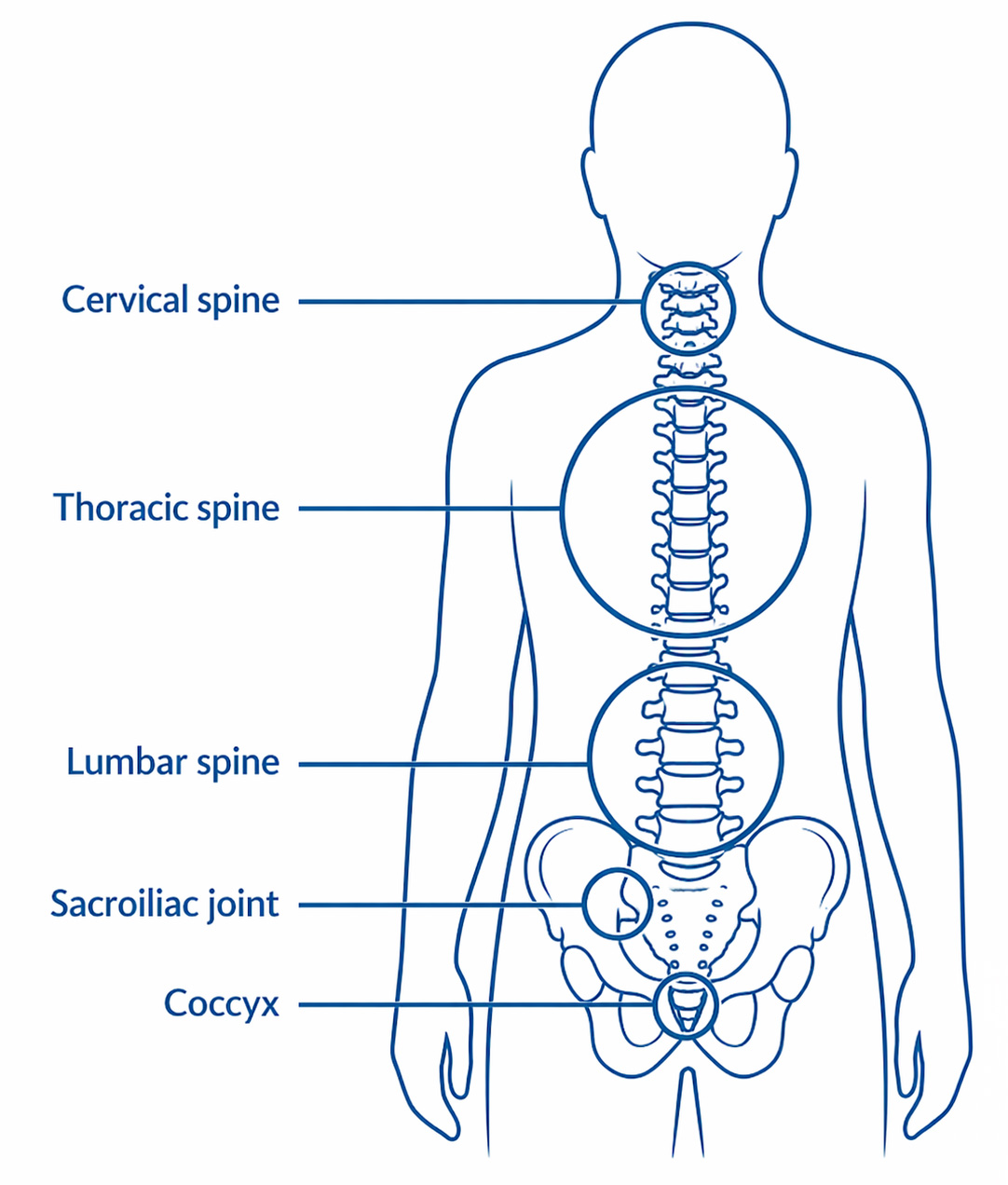
Your lower back (also known as the Lumbar Spine) is made up of 5 vertebrae that protect the spinal cord. They have discs in between to act as shock absorbers when you are walking, running or jumping.
Your lower back moves at the facet joints. You have strong muscles and ligaments around your back that help supports these joints. These all help make your lower back one of the strongest parts of your body. Nerves come out between these joints to supply your legs with sensation (Feeling) and muscle power (For movement).
You may also feel pain and/or pins and needles/ numbness down one or both legs. This could mean that the nerve/s have been irritated (you may have heard this being called a ‘trapped nerve’).
Reasons for low back pain
It is important to realise there is no one risk factor for low back pain with or without leg symptoms. It is can be caused by many different reasons and the Biological, Psychological and Social Model (or Biopsychosocial model for short) shown below is proven to be best for helping us to understand the cause and help with the management of the condition.
Low back pain with or without leg symptoms may be related to genetics (what you inherit from your parents), lifestyle, accidents, smoking or stress. Lifestyle issues may include lack of exercise, being overweight, poor nutrition (not eating a balanced diet) and when you do something that overworks the back too hard, too quickly. The spine is strong and mobile and thankfully back problems are rarely due to anything serious.
Biological factors
- Genetics
- Lack of exercise
- Smoking
- Diet
- Joints/Ligaments/Tendons
- Muscles/Bones/Discs
Psychological factors
- Stress
- Anxiety
- Fear of movement
- Past experiences of pain
- Sleep
- Muscles/Bones/Discs
- Depression
Social factors
- Work-related stresses
- Poor employer relationship
- Poor family relationships
- Social isolation
Symptoms of low back pain
- It is often difficult to put back pain down to one single reason – many things can cause it. Mechanical pain may come from the moving parts of your back (facet joints/ muscles/ ligaments) or the discs but equally it may be described as non-specific which means that we don’t know what is causing the pain.
- Facet joint pain can be similar to a stiff, arthritic finger or knee joint that doesn’t move as well as it used to especially first thing in the morning.
- You need strong muscles to control the movement of the spine and sometimes our muscles are not doing their job properly which can result in pain. Your back is designed to be able to lift and carry loads and is also very flexible. It loves movement!! It does not like to be kept still for long periods of time.
- A strain of the muscles/joints can cause muscle spasm that can travel into your buttock ( bottom) and legs.
- Sometimes the disc can become a little irritated and can bulge or spread a bit – that’s just what discs do and they generally settle with time.
- Fear of movement, previous experiences of pain, stress, anxiety and depression can cause back pain.
- Work-related stresses, poor relationships with family, friends and employers can also cause back pain.
Common symptoms
- Dull ache with or without a sharp pain
- Can come on slowly or with sudden movements
- Usually gets worse in certain positions or with certain movements
- The pain often varies in intensity – sometimes it’s worse than at other times
- The Stiffness/ discomfort is worse for up to 30 minutes in the morning
Nerves help you feel and nerves help you move. The picture below is a guide to show you where the nerves from the lower back provide feeling to the legs. Nerves are like branches in a tree- each nerve supplies a different area of your leg as you can see from the different coloured sections in the picture. Nerves can be irritated by a number of different reasons which can then cause pain spreading down your leg.
- Discs can bulge and irritate the nerve (Sometimes this is called a slipped disc but is important to understand that discs DO NOT SLIP). As a normal part of ageing, discs can bulge without causing any symptoms. If the disc bulge touches a nerve then it can irritate the nerves resulting in nerve symptoms such as pain or discomfort Other factors that can irritate the nerve include inflammation within the nerve, stenosis (narrowing of structures in your spine) to name a few.
- There are two main types of nerves. Nerves which help you feel (sensory nerves) and nerves which help you move (motor nerves). Both of these can be annoyed or irritated.
- This nerve pain can be very distressing and can last for a considerable period of time but generally does start to get better within 3 -4 months. This is a good indication that things are “turning a corner”.
- Other factors that can irritate the nerve include inflammation within the nerve and stenosis (narrowing of structures in your spine) to name a few.
Common symptoms
- Sharp/electric/burning/shooting/stabbing pain which can travel to your foot/ toes.
- Leg pain often worse than back pain (sometimes no back pain).
- Weakness in the leg/s.
Although back and leg pain can get better completely, for some people, it can become a long term issue which can be managed. We call this chronic pain if it has lasted longer than three months. It is worth noting however that leg symptoms can last up to 2 years and still improve.
- Sometimes pain is no longer due to something that’s wrong with the parts of our our back but more related to the fact we are more sensitive to stimuli such as pain and discomfort and our central nervous system (our brain and some nerves) are ‘switched on’ to this pain
- A good way of describing it is that the volume knob on our pain system has been left turned up like a radio stuck on ‘loud’. You can learn to manage this and more information is contained here (link) on the chronic pain website.
Common symptoms
- The pain can come on gradually or with sudden movements
- Dull ache or a sharp pain
- You will usually only feel the pain in the lower back region and into the buttocks although some people have pain right across their back
- The pain often varies in intensity
Visit our NHS Forth Valley Pain Management page for more information.
How common is low back pain?
Up to 80% of the population will experience back pain and a smaller number of people (5-10%) will experience symptoms that travel down one or both legs. Once it gets better a large number of people will have a flare up but the good news is that 80-90% of people who have low back pain will get better within 3 months.
Do I need an x-ray or MRI scan?
X-Rays
A lumbar spine (lower back) x-ray gives you a radiation dose which is the same amount of radiation as 40 chest x-rays. This can be harmful and only gives us information about the bones and joints. For this reason, you will normally only be referred for an x-ray after an accident where you fall from above head height or for a few other very specific reasons, such as osteoporosis.
MRI
A Magnetic Resonance Scan (MRI) can help us take a closer look at your spine. There is a referral procedure for Spinal MRI scans within NHS Lanarkshire.
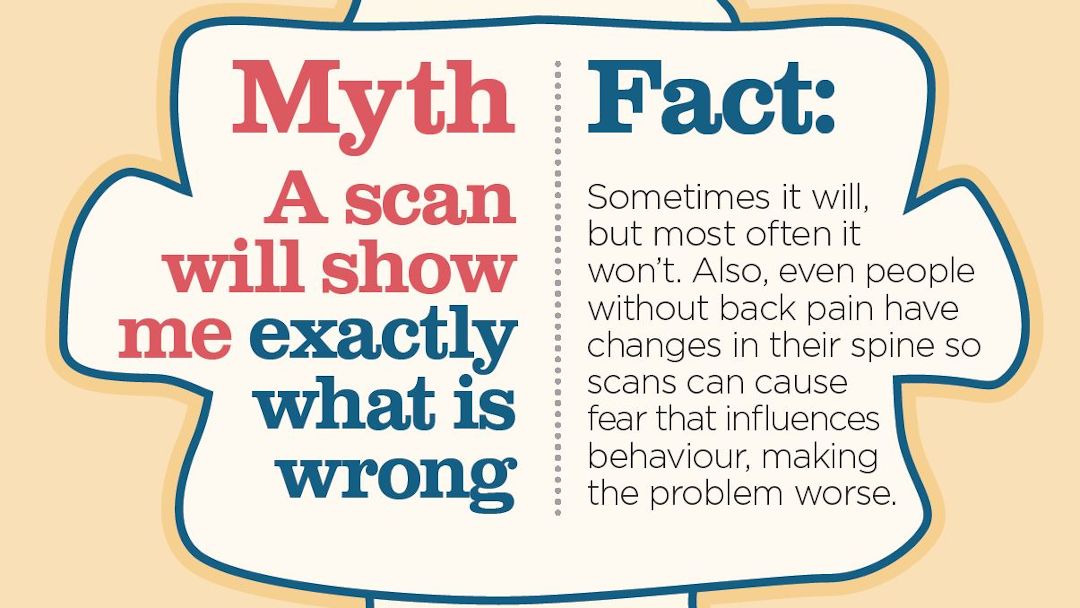
MRI scans are not used to give us a diagnosis, they are used to confirm what we think might be wrong with your back after you have been assessed. The scan shows soft tissues including the muscles and discs and this helps the medical team to decide whether your treatment should be changed (particularly if surgery is being considered).
People often worry about what will show up on an MRI and these feelings can make it harder to cope with pain. If you take a look at the table below which shows the MRI scan results of 3,110 patients without back pain who had MRI scans it shows us the normal age-related changes that we can expect in our spines. This is similar to seeing grey hair and wrinkles in the mirror as we get older!
Findings from MRIs on people with no lower back pain related to their age:
| Age | 20 | 30 | 40 | 50 | 60 | 70 | 80 |
|---|---|---|---|---|---|---|---|
| Disc Degeneration (Ageing of the Spine) | 37% | 52% | 68% | 80% | 88% | 93% | 96% |
| Disc Bulge (Middle of the Disc Bulges Out) | 30% | 40% | 50% | 60% | 69% | 77% | 84% |
Summary
MRI scans are used to confirm a suspected diagnosis and to help guide treatment, mainly if surgery is being considered.
What can help with the condition
A GP can assess you, prescribe medication for your pain as required & refer you onto Physiotherapy or Leisure services where appropriate.
A physiotherapist can assess & treat low back pain. I mainly provide exercise-based treatments & advice on pain management. I may also consider manual treatments. I can also help identify rare and serious problems & ensure that they are managed in the correct way.
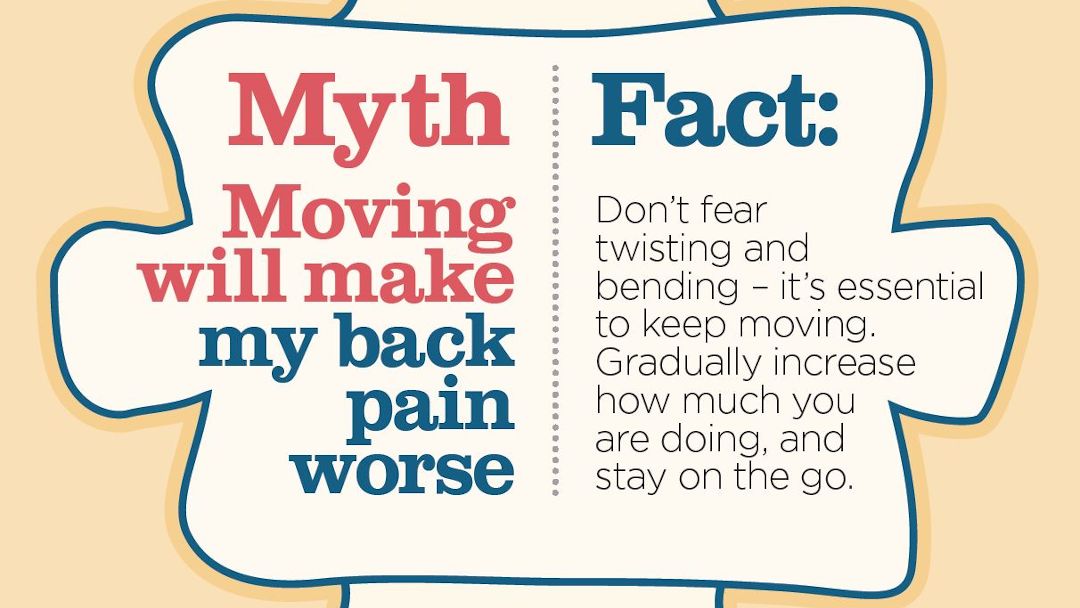
Everyone’s back pain is different and there isn’t one single treatment that works for every person. The treatment and advice that you get from your GP or physiotherapist will be based on the best evidence for your condition and will be tailored to you. Very painful, sudden back pain (we call this an ‘acute episode’) usually gets better within 6 weeks. You can help speed this up by doing exercises and movements that are designed to help your back. Remember – there’s no one exercise that is better than the other for low back pain.
If you have back pain, it is recommended that you:
Take the correct medication that your GP has prescribed
- Get information to help you understand your condition and how to manage it (By reading this you will have that better understanding!)
- Carry on working or return to work as soon as possible. You might find it’s better to have some time off work at the beginning, especially if you have a manual job, but it’s very important for you to return to work as soon as is possible.
- Return to your normal activities as soon as possible
- Exercise regularly by choosing an exercise that you enjoy and that is meaningful to you. The exercise that you do should fit your specific needs, preferences and capabilities. Whatever exercise you choose it is important to start slowly and gradually build up your levels of exercise over time.
- Use strategies to look after your mental health & wellbeing
- Look after your Diet, make sure that you stay at a healthy weight and stop smoking. You can get help with all of these things here.
What about posture?
There is no one posture that is best. If you stay in one position for too long you can become sore and uncomfortable. So the best advice is to keep moving regularly. If your work involves sitting or standing in the same position for long periods of time please break up the day with regular breaks approximately every 20-30 minutes. If your job involves a lot of lifting this rarely causes problems. We know that there is a slight increase in the risk of developing back pain if you lift things weighing over 25kg per day. A certain amount of lifting can be good for our discs and muscles making them stronger
Timescales/Prognosis
If this is your first onset of low back pain it can last up to around 6 weeks. If you have chronic pain then this can be present for a long period of time. With nerve symptoms, this often starts to settle after 3-4 months but can take up to 2 years
Exercises
Exercises designed to improve the movement and strength of your back can be very helpful. It is important to note it can take 6 – 8 weeks of doing specific exercises to notice a difference in your back and leg symptoms. It can take a further couple of months before you feel better.
You should start doing the early exercise videos first and should find them easy before you progress to the middle and late exercises.
When to speak to a professional
Less than 1% have back pain that needs urgent medical attention so you are most likely in the 99%.
Many people have a combination of back pain, leg pain, leg numbness and weakness. These symptoms can be distressing for you but don’t require emergency medical attention. There is a rare, but serious condition, called Cauda Equina Syndrome that does need to be seen by an emergency spinal team.
If you have developed any of the following signs and symptoms that have recently started along with your back/leg pain, phone 111 or attend the Emergency Department as soon as possible:
Cauda Equina Syndrome warning signs
- Loss of feeling/pins and needles between your inner thighs or genitals
- Numbness in or around your back passage of buttocks
- Altered feeling when using toilet paper to wipe yourself
- Increasing difficulty when you try to urinate
- Increasing difficulty controlling your flow of urine
- Leaking urine or recent need to use pads
- Not knowing when your bladder is either full or empty
- Inability to stop a bowel movement or leaking
- Change inability to achieve an erection or ejaculate
- Loss of sensation in genitals during sexual intercourse
If you have recently started to experience any of the following along with your back pain, speak to your GP as soon as possible:
- Feeling unwell
- Pain after a fall or trauma from an accident
- Unexplained weight loss in the last 6 months
- Pain that started when you were ill with another medical condition such as cancer
- Unsteadiness when you walk
If after following the above advice, your symptoms have not improved within 6 to 12 weeks, a referral to a physiotherapist may be beneficial. Speak to your GP about a referral.