


Patellar tendinopathy (Sometimes known as jumpers knee) is a common soft tissue injury which can cause pain in the tendon below the knee cap (patella). It can also cause stiffness and weakness around the knee.
The patellar tendon is important as it joins the thigh muscles (quadriceps) to the shin bone via the patella. The quadriceps are very important as they straighten the knee and are involved in functional everyday activities such as running, walking and going up and down stairs.
Patellar tendinopathy occurs when the patellar tendon is overused/overloaded.
The tendon struggles to cope with the pressure put upon it resulting in micro injuries and changes to its structure. This causes pain.
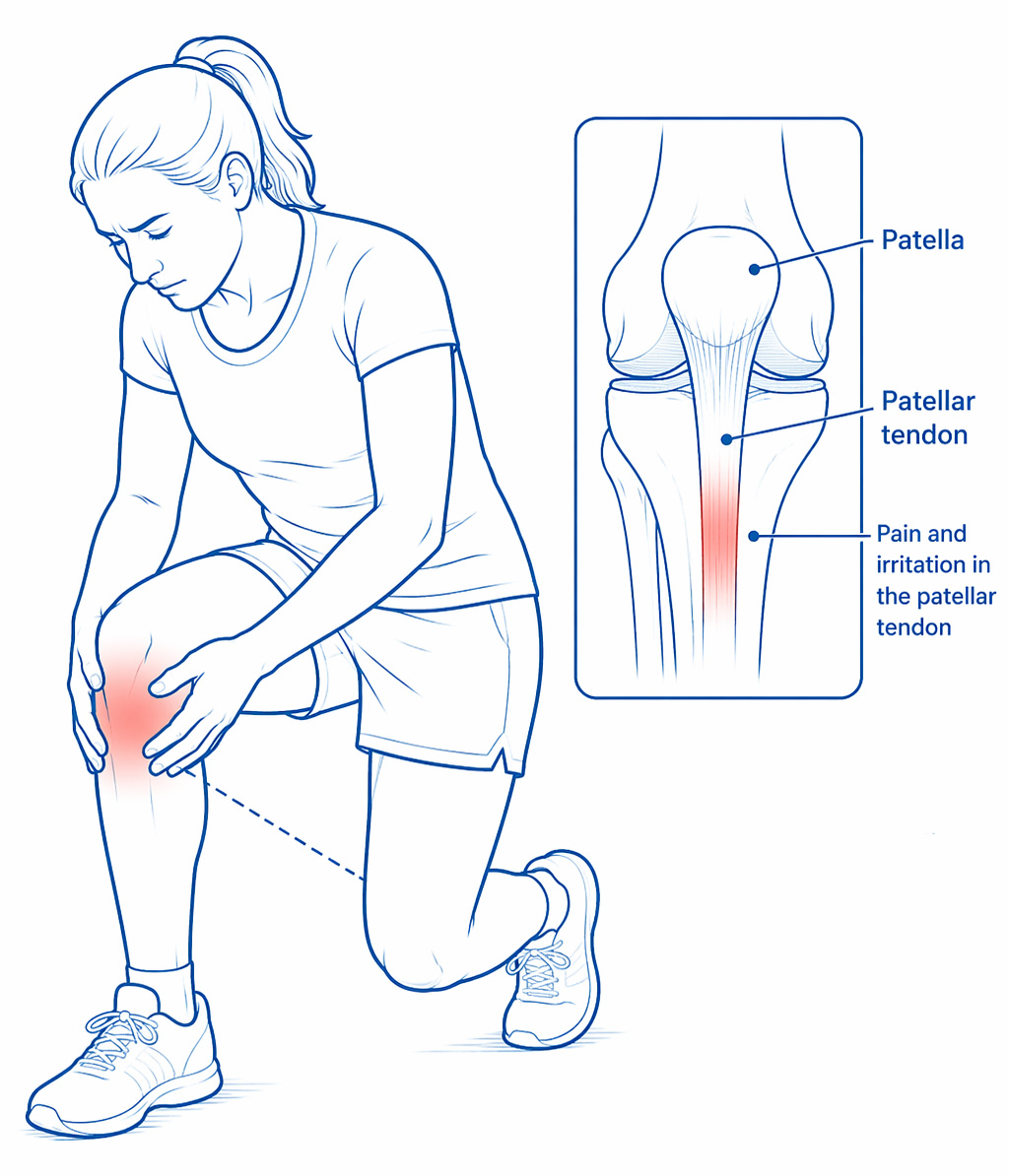
Symptoms of patellar tendinopathy
Symptoms normally appear gradually, but can also develop after a bump to the knee.
- Pain is the most common symptom, localised to the front of the knee (pain can be mild or severe).
- Tenderness on the front of the knee.
- The tendon can sometimes feel a little thickened. Some people can experience tightness or weakness in leg muscles (quadriceps).
- Stiffness in the knee can often occur– especially in the morning.
- Some people can also have mild swelling around the knee.
How common is patellar tendinopathy
Patellar tendinopathy can affect anyone but is more common in the 15-30 years group. However, it is also common in older sporting individuals. It is normally more common in people who take part in jumping, running and hopping activities, such as football and tennis.
What causes patellar tendinopathy?
It is not fully clear why some people develop patellar tendinopathy, but is normally due to several reasons:
- Repeated stress on the patellar tendon
- Overweight individuals
- A sudden increase in body weight
- Tightness of leg muscles
- Weakness in thigh muscles
- Changing activity levels or progressing too quickly
- Inappropriate footwear
- Exercising on hard surfaces
What can help with patellar tendinopathy?
Helpful tips
Generally patellar tendon pain does not get better itself if you continue to put the tendon under too much stress. Patellar tendinopathy can resolve but this can take time. Physiotherapy exercises are recommended to strengthen the tendon. This will help improve the tendons “stress tolerance”.
It is advised that you check your daily activities. You may need to adapt your activity levels for your knee pain to settle. For example, you may need to reduce impact activities such as jumping.
However, it is recommended that you remain active. Low impact activities such as cycling and swimming will help you keep fit whilst you recover.
During physical activity, it is recommended that your pain is less than 3/10 and settles within a 24-hour period (See pain activity ladder).
By following this advice, you should be able to gradually increase your activity levels back to normal.
Other helpful tips:
- Warm up before physical activity
- Regular leg stretching
- Ensure you take adequate rest during your weekly activities
- Don’t start new sport without some practice/ training first
Timescales/Prognosis
An appropriate exercise programme can take more than 3 months to complete. You may see improvements before this but it may take longer for your symptoms to fully resolve.
Pain activity ladder
By following the pain activity ladder you can identify activities that you would consider severely painful, moderately painful and mildly irritating and act to change your habits.
The pain scale, most often used in healthcare, measures pain from 0-10 (zero being no pain and 10 representing the worst pain you could imagine).
If you can identify the level of pain you are experiencing, you will find out if you are in the green, amber or red zone. The best way to move down to the green zone is by pacing and spacing your activity.
When you are completing your rehabilitation exercises it is often best to work within the green (and sometimes amber zones depending on what you deem is an acceptable level of pain) both during the exercises and within 48 hours of completing your exercises. If you find yourself in the red zone you are likely pushing yourself too hard and may flare up the pain.
Pacing and spacing
Pacing and spacing methods can help you manage your pain better.
Pacing is the term used for breaking down an activity or task. This can be done by taking regular breaks. Prioritising daily activities can also help. This can prevent “over stimulating” your pain system.
When completing challenging tasks or activities, it may be useful to set a “baseline”. This is the amount you can manage on a good or bad day without increasing your symptoms. Therefore, you can plan rests and set achievable goals.
When to speak to a professional
If you find any of the above exercises worsen your symptoms, please stop and seek advice from a health professional.
Please seek immediate medical attention by phoning 111 if you experience knee trauma/injury with:
- A sudden pop/snap sensation
- Severe pain/swelling
- The inability to straighten your knee
If you experience swelling, redness with heat around your knee, please seek advice from your GP.
If after following the above advice, your symptoms have not improved within 6 to 12 weeks, a referral to a physiotherapist may be beneficial. Speak to your GP about a referral.