


Osteoarthritis (OA) is a joint condition where there is decline of the joint cartilage and the bones next to the cartilage.
The end of the bones in a joint are covered in protective cartilage. This cushions and allows for smooth movement of the joint. The joint is lubricated and nourished by synovial fluid. In OA, the body is not as efficient at repairing the cartilage and there can be joint swelling due to excess synovial fluid. Bony growths may develop next to the joint. Pain and stiffness might result in a reduced use of the joint, causing a weakening of the surrounding muscles.
OA in the hand mainly affects the base of the thumb and the small joints of the fingers.
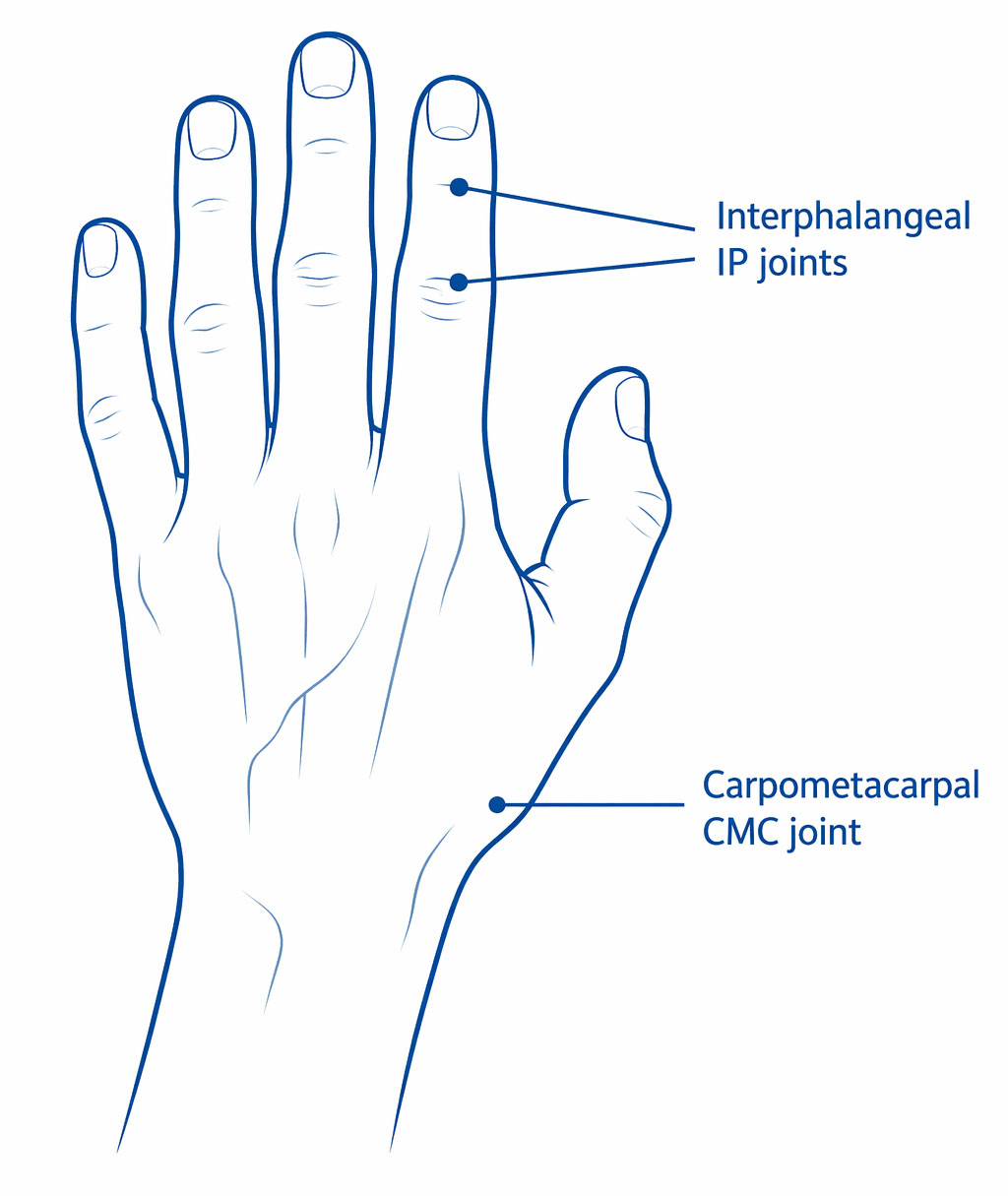
Symptoms of osteoarthritis of the hands
- Pain: Mainly on movements or activity. Normally reduces at rest. Sharp or aching pain.
- Stiffness and reduced range of motion: Stiffness mainly following rest. Can be difficult to open thumb away from hand if the thumb CMC joint is affected.
- Tenderness if you press the affected joint.
- Difficulty with tasks and reduced grip strength: can be difficult to grip or pick up objects.
- Swelling of the affected joint.
- Deformity in advanced OA: The affected joint might look bigger and there may be changes in the posture of the CMC joints. Bony nodules on the affected finger joints may develop.
How common is it?
The hand is one of the most common joints affected by osteoarthritis.
The effects tend to worsen as we get older. It is much more common in women, especially after the age of 55. However, after the age of 70 both males and females are more equally affected.
What causes it?
The hand joints are exposed to a constant low level of trauma in our everyday life and our joints go through a repair process. The joints go through this ‘wear and repair’ process also in OA. In some cases, the repair process does not manage to fully compensate for the wear, eventually leading to a symptomatic presentation of OA.
There is not a known specific cause for OA. However, several causes can play a role in the development of hand OA. These include:
- Age: The prevalence of OA increases with age
- Gender: More common in women than men
- Genetics: The tendency to develop OA may be inherited
- Previous joint injuries, abnormalities or hand surgery
- Overuse of joint (e.g. occupation): Repetitive pinch-type activities and strong grip activities can place high loads through the joints.
What can help osteoarthritis of the hand?
It is important to remember that many adjustments and treatments can help relieve some of your symptoms. OA doesn’t always worsen through time and there are things that you can try to help your symptoms.
Research supports a mixture of treatments including:
- Exercise
- Medication
- Use of heat or cold
- Supports/splints
- Advice on self-management
There is more information below:
Helpful tips
- Spread activities or jobs over a day or a week, especially if a lot of gripping or repetition is required.
- Consider spreading loads/activities to other joints e.g. using two hands instead of one, switching hands.
- Take notice of any increase in pain that you feel during/after an activity – is there anything you could have done to help to reduce this?
- Consider pacing and spacing and the pain activity ladder
- Use labour-saving gadgets or devices where possible. E.g. in the kitchen, at work, gardening. Anything that makes it easier will help. Occupational therapy can help with advice.
- Make sure that tools/equipment at work or for your hobbies are properly maintained i.e. oiled or sharpened.
- Avoid actions that take or push your joints into awkward positions.
- If an activity causes you difficulties, stop and think if there might be an easier way of doing it next time.
- Arthritis UK have produced a guide with more information on how to look after your joints.
- If you have problems with activities at work, it may be helpful to ask for a workstation/workplace assessment or talk with your manager or Occupational Health Department. This can help with alterations or provision of equipment or altering your working day or tasks.
Timescales/Prognosis
- It is worth noting that the symptoms experienced and the changes seen on an X-ray often do not match.
- OA will NOT always get worse through time.
Pain activity ladder
By following the pain activity ladder you can identify activities that you would consider severely painful, moderately painful and mildly irritating and act to change your habits.
The pain scale, most often used in healthcare, measures pain from 0-10 (zero being no pain and 10 representing the worst pain you could imagine).
If you can identify the level of pain you are experiencing, you will find out if you are in the green, amber or red zone. The best way to move down to the green zone is by pacing and spacing your activity.
When you are completing your rehabilitation exercises it is often best to work within the green (and sometimes amber zones depending on what you deem is an acceptable level of pain) both during the exercises and within 48 hours of completing your exercises. If you find yourself in the red zone you are likely pushing yourself too hard and may flare up the pain.
Pacing and spacing
Pacing and spacing methods can help you manage your pain better.
Pacing is the term used for breaking down an activity or task. This can be done by taking regular breaks. Prioritising daily activities can also help. This can prevent “over stimulating” your pain system.
When completing challenging tasks or activities, it may be useful to set a “baseline”. This is the amount you can manage on a good or bad day without increasing your symptoms. Therefore, you can plan rests and set achievable goals.
Splints and supports
- Splints and supports may be helpful along with other treatments.
- They can include supports for the fingers, thumb and wrist.
- They aim to reduce pain and stress through the joints, and improve stability and support. This can help reduce swelling and improve the function of your hand.
- They can be ‘off the shelf’ or made to fit you by an Occupational Therapist, Physiotherapist or Orthotist.
- Other supports can include compression gloves and silicon tubes for the fingers.
- It is recommended that you talk with a relevant Health Professional for the assessment and provision of these items. They will also be able to advise you on the best way to use them.
- Alternatively here you can follow these instructions on how to measure and purchase Wrist Splints and Thumb Spicas
This leaflet gives some simple advice on buying a wrist support.
The examples in this leaflet are suggestions and will give you an idea of what a wrist splint should look like. These splints cost around £10-£15 for one splint.
Does it have to be a certain design?
Your wrist splint should have a metal bar in them to limit wrist movement. It should not limit your thumb or finger movement.
If you are going to use your splint to treat Carpal Tunnel Syndrome, you should flatten the bar of the splint. This reduces the pressure on the nerve at the wrist.
Flatten the splint by placing the splint on the edge of a table and gently pushing the end down so that it is flat.
How are wrist splints usually sized?
Wrist splints are usually supplied in small, medium, large or extra-large sizes. The size required is usually based on measuring around the wrist with a tape measure. Different suppliers may use different methods to size so always check.
Where do I get a splint from?
You can order wrist splints online or from a Pharmacy/Chemist. Please check with your local branch.
You can also order from the following companies. Other stockists and suppliers are available.
- Promedics:
- Phone number 01475 746410
- Order online at http://www.promedics.co.uk
- Performance Health:
- Phone 08444 124 331
- Order online at http://performancehealth.co.uk
This leaflet gives some advice on buying a thumb splints. The examples in this leaflet are suggestions and will give you an idea of what a thumb splint should look like. These splints cost around £10 for one splint.
Does it have to be a certain design?
Your thumb splint should have an internal bar in it to limit movement at the base of your thumb. It should not limit your thumb tip or finger movement. It should be easy to take on and off. Splints come in two main types.
How are thumb splints usually sized?
Thumb splints are usually supplied in small, medium, large or extra large sizes. The size required is usually based on measuring around the wrist with a tape measure. Different suppliers may use different methods to size so always check.
Where do I get a splint from?
You can order wrist splints online or from a Pharmacy/Chemist. Please check with your local branch.
You can also order from the following companies. Other stockists and suppliers are available.
- Promedics
- Phone number 01475 746410
- Order online at http://www.promedics.co.uk
- Performance Health
- Phone number 08444 124 331
- Order online at http://performancehealth.co.uk
When to speak to a professional?
If you have any of the following symptoms please contact your GP.
- If your pain levels, swelling, or colour changes significantly worsen
- If you notice a significant increase in these symptoms affecting other joints
- If you find that early morning stiffness is lasting longer than 30 minutes
- If you are feeling generally unwell (such as fever) in combination with the joint symptoms
If after following the above advice, your symptoms have not improved within 6 to 12 weeks, a referral to a physiotherapist may be beneficial. Speak to your GP about a referral.