


An ankle sprain is an injury that usually occurs at the outside of the ankle when you twist and/or land awkwardly on it.
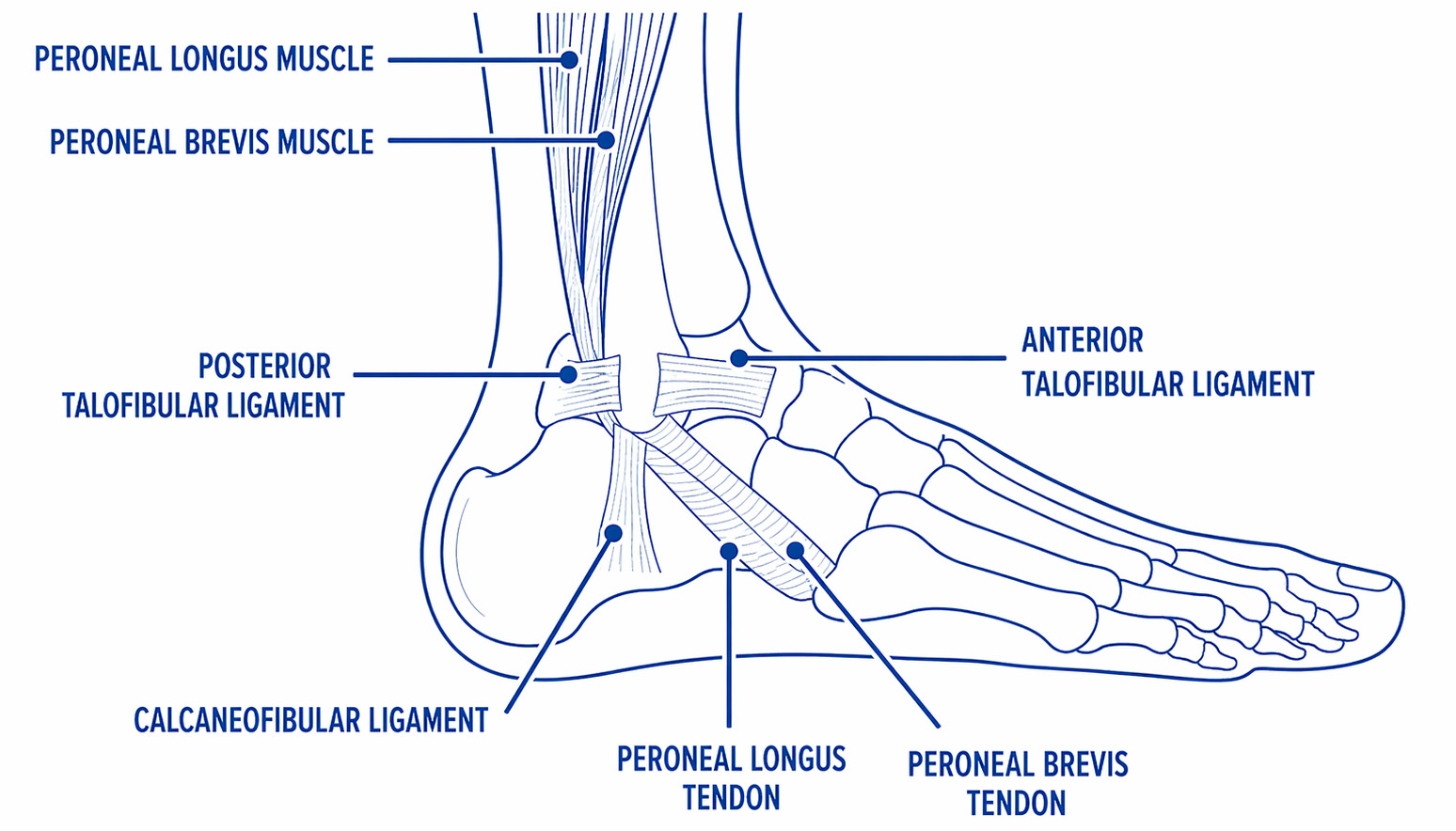
The tissues commonly injured in an ankle sprain are the ligaments. Ligaments are bands of connective tissue within the body that normally help to stabilise the joint by stopping unwanted movement. Following this injury, most people commonly experience pain, swelling, loss of function and sometimes an inability to fully weight bear.
There can be differing degrees of ankle sprain, therefore your recovery time depends on the degree of injury you sustain. Recovery can take anything from a few weeks to several months.
What are the symptoms of an ankle sprain?
People can experience the following symptoms:
- When you injure your ankle, you may hear a ‘popping’ sound or feel like your ankle has given way.
- Pain, especially on weight bearing.
- Swelling round the outside of the foot and ankle. This can be minor however some people experience a big amount of swelling.
- You may experience bruising around the outside and/or inside of the ankle and this may spread into the foot and even down to the toes. This can worsen over a few days following the injury. If it doesn’t happen immediately it is not on its own a cause for concern.
- When touching the painful area, you may experience some tenderness or pain.
How common are ankle sprains?
An ankle sprain is one of the most common lower limb musculoskeletal injuries experienced, especially in the physically active. Up to 70% of people will experience this in their lifetime. Recurrence of this injury is very common, especially in the first year following the first injury.
What causes an ankle sprain?
A sprained ankle happens when you roll over the outside of your foot and your foot turns inwards. This normally occurs rapidly and you don’t get enough time to react. A sudden and rapid inward twisting force – or inversion injury is where the ligaments and muscles are over-stretched, sometimes torn or in rare cases ruptured. More rarely, your foot and ankle can move in the opposite direction over the inside of the foot resulting in strain to the stronger deltoid ligaments located on the inside of your foot. You can also develop ankle pain when your foot ankle flexes up the way rapidly or you twist your body round with your foot remaining planted on the ground.
Common causes of an ankle sprain are:
- Sudden change in direction/twisting movement
- Impact during sport/recreational activity
- Walking, running or exercising on uneven ground/terrain (for example walking across cobbles)
- Twisting on a planted foot (for example studs getting caught on a football field)
- Tripping or missing a step on the stairs – common in high heels.
Timescales/Prognosis
The pain from your ankle sprain should subside quickly, usually within 2 weeks. Only a small percentage of people may experience long-term pain after their injury.
There are differing severities of an ankle sprain. They can be categorised into mild/moderate/severe:
- A mild ankle sprain can heal within a few weeks with self-management.
- A moderate ankle sprain can take a few weeks to recover, however, you may be at risk of re-injuring your ankle within the first few months following injury.
- A severe ankle sprain may take several months to recover, and some cases may require surgical intervention.
Ankle sprains have a high re-injury rate. You are at high risk for re-injuring your ankle in the first year following your sprain.
Most people return to normal function within 6-8 weeks and return to activity and sport within 8-12 weeks.
Pacing and spacing
Pacing and spacing methods can help you manage your pain better.
Pacing is the term used for breaking down an activity or task. This can be done by taking regular breaks. Prioritising daily activities can also help. This can prevent “over stimulating” your pain system.
When completing challenging tasks or activities, it may be useful to set a “baseline”. This is the amount you can manage on a good or bad day without increasing your symptoms. Therefore, you can plan rests and set achievable goals.
Pain activity ladder
By following the pain activity ladder you can identify activities that you would consider severely painful, moderately painful and mildly irritating and act to change your habits.
The pain scale, most often used in healthcare, measures pain from 0-10 (zero being no pain and 10 representing the worst pain you could imagine).
If you can identify the level of pain you are experiencing, you will find out if you are in the green, amber or red zone. The best way to move down to the green zone is by pacing and spacing your activity.
When you are completing your rehabilitation exercises it is often best to work within the green (and sometimes amber zones depending on what you deem is an acceptable level of pain) both during the exercises and within 48 hours of completing your exercises. If you find yourself in the red zone you are likely pushing yourself too hard and may flare up the pain.
When to speak to a professional
You should consider attending the Emergency Department or phoning 111 if you have any one of the following:
- You are unable to fully weight bear and take 4 steps or more immediately after injury
- If your foot is discoloured and this is not normal for you
- If you experience altered sensation following injury which is lasting
- Immediate bruising and/or gross swelling
- Your ankle looks to be misshapen
- If you have a known blood disorder
If after following the above advice, your symptoms have not improved within 6 to 12 weeks, a referral to a physiotherapist may be beneficial. Speak to your GP about a referral.